ACOMSDave

Community Journalist

  • Home
  • Community Journalist
  • Events
  • Media Page and Press Kit
    • Projects and Work
  • Resources & Documents
    • LGBTQ+ Support Groups and Documents
  • NIGRA
  • Archives
  • Contact

Could one court ruling force Northern Ireland to allow gay marriage ?

15/01/2015 By David McFarlane Leave a Comment

Gay couple married in England are hoping to have their marriage recognized in Northern Ireland
13 JANUARY 2015 | BY JOE MORGAN
Northern Ireland's gay marriage ban could be overruled this week.

A gay couple married in England could be the key in same-sex marriages being recognized in Northern Ireland.
In a court ruling this week, to be heard at Belfast high court, a decision could lead to the UK as a whole allowing gay couples to get legally married.
The couple, who have asked to remain anonymous, will call on Northern Ireland to make a declaration their marriage remains lawfully constituted where they are living now and should be recognized on Thursday (15 January).
John O’Doherty, director of The Rainbow Project, is backing the couple.
‘We are very happy to support this important legal challenge. While same-sex marriage legislation in Westminster had many positive aspects, we believe that its provision forbidding the recognition of lawful same-sex marriages in Northern Ireland is irrational, contrary to principles of British constitutional law and incompatible with the European convention on human rights,’ he said.
‘We are resolute in our assertion that no one can be married in one part of the United Kingdom and then not married in another.
‘Once a couple is lawfully married in the UK, we contend that their relationship cannot be reclassified as a civil partnership without their consent, which is exactly what the law currently does.
‘The legislation says to lawfully married people that they are no longer married. This is unconscionable and cannot be permitted to continue.
‘Marriage is a fundamental human right, which is now recognised in the UK as including same-sex couples. We will work to ensure that this right is realised for everyone in the United Kingdom and we are confident that marriage equality will be achieved in Northern Ireland.’
Without the ruling, Northern Ireland is expected to be the only main part of the British and Irish islands that ban same-sex marriage by the end of the year.
Ireland itself will be voting in a referendum in May. In the last Irish Times/Ipsos MRBI poll, it found 71% supported marriage equality in Ireland.

– See more at: http://www.gaystarnews.com/article/could-one-court-ruling-force-northern-ireland-allow-gay-marriage130115#sthash.QY9YasKu.dpuf

Filed Under: Anti-Bullying & Homophobia Tagged With: courts, gay marriage, legal, Northern Ireland

Nothing Like A Dame… Part 2

12/01/2015 By David McFarlane Leave a Comment

By The Gay UK, Dec 31 2014 03:00PM
In the New Year Honour List announced yesterday Kirsten Scott Thomas became one of the youngest women ever to be made a Dame.
Kristin_Scott_Thomas
The actress who resides in France these days and best known for her Oscar nominated performance in The English Patient is a mere 54 years old. Most members of this group of illustrious women she is now joining are ‘elderly’ although this not a term one would dare to use describing another new ‘member’ Dame Joan Collins even though she is now 81 years old.
May QuantFashion designer Mary Quant credited with introducing the miniskirt in the Swinging Sixties is also made a Dame some 50 years after the Queen gave her an OBE, and joining her on the list is the ex Television Presenter and founder of Childline Dame Esther Rantzen.
John Hurt
Also amongst the List we espied that the wonderful actor John Hurt had finally been knighted. Sir John is hardly a Dame, but we hold him in such high esteem after his unforgettable performance as Quentin Crisp in The Naked Civil Servant that we feel like he could be an ‘honarary one’.
by Roger Walker-Dack

Filed Under: Anti-Bullying & Homophobia Tagged With: dame, dames, honours, lists

Edwin Poots: ban on gay blood was biased, High Court rules

09/01/2015 By David McFarlane Leave a Comment

Previously we have commented and written about the ex-Minister Edwin Poots apparent bias (prejudice) against the LGBT community.
 
2013/9/19 – Article on Minister’s use of public funds defending the appeal againsgt his ban on gay blood donations and gay adoption.
2013/9/21 – Petition for Minister’s resignation
2014/12/25 – The US Food and Drug Administration (FDA) has recommended the end of a three-decade ban on blood donations
 
Former Stormont's Health minister Edwin Poots.Today we are reprinting the news article from BBC News reporting on the judicial case and Mr Justice Treacy’s comments  that the Ban by Edwin Poots ‘infected by apparent bias’.  The verdict strengthens a previous finding in October 2013 that the ban is irrational.
 
The gay blood ban, put in place during the 1980s AIDS threat, was lifted in England, Scotland and Wales in November 2011.
A former health minister’s ban on the donation of blood from gay men in Northern Ireland was “infected by apparent bias”, a court has ruled.
A judge also backed claims from lawyers for a gay man that Edwin Poots’ stance was influenced by Christian beliefs.
The High Court ruling strengthens a previous finding in October 2013 that the ban was irrational.
Mr Poots, who is to appeal that ruling, was replaced as Stormont’s health minister last year.
The gay blood ban, put in place during the 1980s AIDS threat, was lifted in England, Scotland and Wales in November 2011.
The minister has consistently rejected claims that his position may have been influenced by his religious views
It was replaced by new rules which allow donations from gay men who had not had sexual contact with another man for more than a year.
But Mr Poots maintained the prohibition in Northern Ireland on the basis of ensuring public safety.
The minister has consistently rejected claims that his position may have been influenced by religious views.
But lawyers for the gay man who brought the challenge, introduced remarks made by Mr Poots in the Northern Ireland Assembly.
The DUP MLA was recorded as saying: “There is a continual battering of Christian principles, and I have to say this – shame on the courts, for going down the route of constantly attacking Christian principles, Christian ethics and Christian morals, on which this society was based and which have given us a very good foundation.”
The judge cited a news article from 2001 in which Mr Poots spoke of the rights of those receiving donations to be told they were getting “clean blood” uncontaminated by the HIV virus.
He added: “The minister’s very troubling lack of candour and his attempt to conceal the fact that he had made a decision are plainly circumstances that are material to whether a fair-minded and informed observer would conclude that there was a real possibility of bias.”

  •  http://www.bbc.co.uk/news/uk-northern-ireland-30733667
  • http://www.belfasttelegraph.co.uk/news/local-national/northern-ireland/edwin-poots-ban-on-gay-blood-was-biased-high-court-rules-30892626.html
  • http://en.wikipedia.org/wiki/Edwin_Poots


Filed Under: Anti-Bullying & Homophobia Tagged With: blood ban, court case, Edwin Poots, homosexual bias, legal ruling, Northern Ireland Health Minister

A campaign against homophobia will be held during Baku European Games

09/01/2015 By David McFarlane Leave a Comment

 
As we know, Baku is hosting First European Games this year. Nefes LGBT Azerbaijan Alliance will hold “Compete 4 Equality” campaign during this event. The target group of this campaign is European Parliament, International Olympic Committee, ILGA World and ILGA Europe, Olympic Committees and Ministries of Foreign Affairs of European Council member states, and international organizations working with human rights. Of course, holding this campaign doesn’t mean the cancellation of Baku European Games. The goal is to draw the attention of Europe and the world to the current situation of homophobia and fundamental human and LGBT rights in Azerbaijan, as well as achieving the needed action from the government for improving the current situation in the country. During this campaign, the logo of First European games will be used in rainbow colors in order to achieve the main goal.
The main goal of our first stage is to bring attention to the positive message of our “Compete 4 Equality!” campaign in local and international public spheres. We will hold support campaigns in front of Azerbaijan embassies around the world. Local LGBT organizations and individuals from anywhere can take a photo with the rainbow flag, our slogan “Compete 4 Equality!” and the Azerbaijan embassy in the background and send them to nefeslgbt.az@gmail.com.

We need cooperation with all of which have interests in this campaign totally. Please join us and help support us and the LGBT community in Azerbaijan. Be the intermediary to spread the positive message of our campaign.
10913633 1038103689540551 56682449 n
Click the Pink Compete for Equality to be taken the site and VOTE YES!!
Javid(Atilla) Nabiyev
President of Nefes LGBT Azerbaijan Alliance
tel | +994553407008
e-mail | nefeslgbt.az@gmail.com
facepage | facebook.com/nefeslgbt
twitter | @LGBT_Azerbaycan
web | lgbtaz.org/

Filed Under: Anti-Bullying & Homophobia, Campaigns Tagged With: azerbaijan alliance, baku, homophobia, LGBT, nefes

Meet the Russian who would have bee Mary Whitehouse's bed-fellow

28/12/2014 By David McFarlane Leave a Comment

Shades of Mary Whitehouse and her moral indignation come to mind when I read this article.
Constance Mary Whitehouse, CBE (née Hutcheson, 13 June 1910 – 23 November 2001) was an English social activist known for her strong opposition to social liberalism and the mainstream British media, both of which she accused of encouraging a more permissive society. She was the founder and first president of the National Viewers’ and Listeners’ Association, through which she led a longstanding campaign against the British Broadcasting Corporation (BBC). A staunch social conservative, she was disparagingly termed a reactionary by her socially liberal opponents. Her motivation derived from her traditional Christian beliefs, her aversion to the rapid social and political changes in British society of the 1960s and her work as a teacher of sex education.
 
Now ‘Meet the Russian who has had over 30 teachers fired for being gay’

 Pictures of teachers hugging loved ones is being sent to officials in order to have them fired for ‘immoral behavior’
26 DECEMBER 2014 | BY JOE MORGAN
Timur Isaev: Persecuting LGBTI teachers in Russia.

A music teacher who worked with disabled children in St Petersburg was fired for being gay this month, the latest in a long line of educators who have become victims of Russia’s ‘gay propaganda’ law.
Anastasia (not her real name) was called into the principal’s office on 8 December. She was told that pictures of her hugging her girlfriend had been forwarded to the school and a demand she be fired for ‘immoral behavior’.
The pictures and demand was also sent to local government officials.
‘You belong with gay people,’ the teacher was told. ‘You are not allowed to work with children.’
This was another ‘win’ for Timur Isaev, a man who boasts he has had over 30 teachers fired for being gay.
Among his other victims include Ilya Kolmanovsky, an award-winning biology teacher at a top public school, who was fired in January.
‘I have been fired from the school where I worked for seven years,’ he wrote on Facebook.
‘My opponents found about me and my school and sent complaints to the administration, and on Monday the principal told me he is firing me to save the school.’
‘I don’t blame the principal,’ he added. ‘He knows better who is dealing with.’
Isaev does not hide the fact he is helping teachers get fired. On his VK page, it reads: ‘Russia – It’s hell for gays, let them get used to it!’
‘If people are unhealthy and have psychiatric abnormalities such as being a lesbian, then it is clear the law states they are unacceptable for doing this type of work,’ he says.
‘Homosexuality is not normal,’ he told Meduza. ‘It is a disease that is treated with hormone therapy.’
He is now working to fire other teachers, making sure no other LGBTI person ‘influences’ a child.
The nationwide ‘gay propaganda’ law was enforced in Russia in June 2013.

– See more at: http://www.gaystarnews.com/article/meet-russian-who-has-had-over-30-teachers-fired-being-gay261214#sthash.9eithlYN.dpuf

Filed Under: Anti-Bullying & Homophobia Tagged With: homophobia, mary whitehouse, persecution, Russia, teachers

Watch teaser: First gay local high school drama to hit Australian screens

28/12/2014 By David McFarlane Leave a Comment

Producers expect to show the pilot episode at festivals next year with hopes of a TV pick-up later in 2015

27 DECEMBER 2014
Cast of Subject to Change

Photo: Subjecttochange.com.au
An independent coming-of-age drama featuring same-sex attracted lead characters at a suburban Australian public high school is expected to hit local and international screens next year.
‘Through its coming-of-age narrative, Subject to Change will confront the harsh difficulties faced in suburban Australia by following these young adults as they deal with their complex and conflicting emotions. It will be a rocky road to love and inclusion through their final years of high school,’ the website reads.
Creator and executive producer by Daniel Mercieca said, ‘We’re setting it in a suburban Australian public high school, well outside the inner city comfort zone of rainbow flags and wear-it-purple days.’
‘It’s going to be a rough, homophobic experience for young same sex attracted students.’
The independently produced pilot episode of the television program is currently in post production and producers hope to show it at festivals next year.
A thirteen episode series of 22-25 minute episodes is currently in development.
Mercieca added that they currently have no development funding and are seeking discussions with interested co-producers in the new year.

– See more at: http://www.gaystarnews.com/article/watch-teaser-first-gay-local-high-school-drama-hit-australian-screens271214#sthash.szOL5S6s.dpuf

Filed Under: Anti-Bullying & Homophobia Tagged With: Australia, gay, teen, tv drama

Coming out online as a gay teen: Good or bad?

28/12/2014 By David McFarlane Leave a Comment

For those who missed this interesting tit-bit, I reprint it from the BBC Newbeat Site (Coming out…)
 

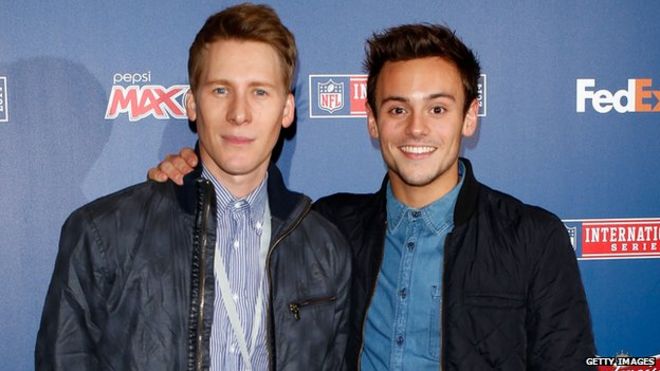
Tom Daley with his boyfriend Dustin Lance Black

In 2013, Tom Daley used the internet to come out publicly, posting a video on YouTube.

At the time he said: “My life changed massively when I met someone, and they make me feel so happy, so safe and everything just feels great. That someone is a guy.”
For someone in the media spotlight, it was a bold move to do it so publicly.
But what’s it like for other gay teenagers wanting to come out? Does the internet make it easier?
As a guest editor of BBC Radio 4’s Today programme, singer Tracey Thorn wanted to find out whether that was the case.
She’d noticed a lack of positive stories about young people and the internet so got author and presenter Damian Barr to sit down with several gay teenagers to find out how the internet helped them, or not.
Here are Maddie and Tom’s stories.

Gay pride flag

Maddie, 16

“I think the first person I told physically was a teacher. She wasn’t gay. She was just a nice person and I think I was 13.
Before that I talked to quite a lot of people online, who gave me the courage to come out at school.
I actually met my ‘best internet friend’ over a fan-fiction website. We wrote about Glee! I met my other ‘best internet friend’ through Tumblr.
I told her that I really liked her blog and she became one of my main support systems. We’ve actually met twice in real life which was pretty surreal.
The internet was the only thing I had prior to coming out. I wasn’t specifically looking for gay people, they just seemed to be there.
I came out on Facebook. I put a post saying ‘There are rumours I’m a lesbian and I’m not going to deny that’ and I got loads of good responses on the Facebook status
But I also had an ask.fm account attached to my Facebook and had hundreds of messages telling me to kill myself.
I think it was just a few people sending a lot of messages so it was really difficult. I should be allowed to have internet access without the fear of abuse.”

Tom, 16

“I recently told my teacher and cried in front of her. I was really embarrassed and did not know how she’d react but I felt much stronger and more powerful as a result. I thought that someone does accept me!
I don’t think I came out online but the internet helped me find the resources to come out and to be sure I am interested in men only because I was really confused about whether that was my sexual orientation.
I realised that’s what I like and it won’t change. The internet helped me to realise that’s my reality.
I also watched gay Youtubers talk about how they know. I think I watched every single gay title about coming out. It made me feel that I’m not alone and there is somewhere I belong.
People also asked me on Facebook ‘are you gay?’. I was really hurt because I believed being gay was a curse. It’s been hurtful but I’m really happy to be over it.”

Filed Under: Anti-Bullying & Homophobia Tagged With: BBC, coming out, online, Tom Daley

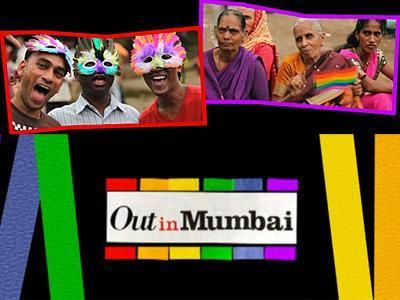
Out in Mumbai Director Adele Tulli on India's Queer Future

25/12/2014 By David McFarlane Leave a Comment

I was given a DVD of this doucmentary some time ago, and unfortunately forgot that I had it.  I found it very interesting, firstly as it is a continent that I have not explored, and secondly as I have some gay friends living and working in India.  Sunneil and Leslie worked with me in the Middle East, and then returned to India.
They have often been in my thoughts, and having watched the documentary it has re-ignited my interested in going to visit them.
Try and find the full documentary and watch it – you will be enthralled by the diversity and the culture.
The documentarian discusses LGBT life in India after the repeal of the country’s most notorious antigay law.

Republished from The Advocate BY Daniel Villarreal

March 28 2013 4:00 AM ET

Adele Tulli


Adele Tulli’s documentary Out in Mumbai, which follows three LGBT Indian natives in the run-up to Mumbai’s first Pride celebration, begins with a focus on Section 377 of the Indian Penal Code. It is a colonial-era law criminalizing any sexual activity “against the order of nature,” particularly intercourse between adults of the same sex.
On July 2009, the High Court of Delhi overturned the 150-year-old law as it violated consenting adults’ constitutional right to legal equality before the law.
We spoke to Tulli about her documentary — which premiered this month on the gay TV network HereTV — and about the future of India’s LGBT movement, the role she hopes her film plays in moving Indian queer rights forward, and more.
The Advocate: What compelled you to make the documentary and how did you go about finding its subjects?
Adele Tulli: I have been traveling to India for the last 10 years, lots of different reasons brought me there, among those my studies. I studied South Asian studies, focusing on social movements in contemporary India, mainly feminist and LGBT movements. When Section 377, the colonial law that criminalized homosexuality in the country, was finally repealed in 2009, the impact was amazing. LGBT issues were all over the news and for the first time the whole indian society had to acknowledge them. I was in Mumbai a year later and the energy among the LGBT community was still so vibrant. We were preparing the celebrations for the first anniversary of Section 377’s repeal and there came the idea of making it into a film. The documentary follows three people from Mumbai’s LGBT community that find themselves in the middle of this historic moment of India’s LGBT history. They are all close friends who were willing to share their personal stories, so to find them was not so difficult.
What have been your personal experiences with LGBT discrimination and community in Mumbai?
I recognize the importance of identity politics at a political level, but at a personal level I tend to avoid labels. If I had to choose one, maybe I would say queer. It depends on the context, if I am with a girlfriend in a very hetero-normative context, I would definitely call myself a lesbian. My experience with LGBT discrimination in Mumbai is not so different from a lot of other places where being gay is still very hard, Italy, where I come from, included. While I consider myself lucky to have had the opportunity of being in Mumbai during the first year of freedom of the LGBT community, the energy was so empowering. After years of invisibility, the struggles of the community were finally acknowledged and even if a law does not change society in one day, the impact it had on people was extraordinary. So many people came out, joined the community, and so many LGBT events, support groups, organizations were born.
According to Wikipedia, “The [Section 377] has not been used against homosexuals (or against consenting adults) is borne out by the history of convictions under this law in India, wherein there has been no case of a consensual homosexual act being prosecuted / convicted under this act.” Is this true?
It is true that convictions under the law were rare, but the main problem of Section 377 was that it was often used by police and social bigots to intimidate, threaten, harass and blackmail the gay and hijra community, preventing them from accessing legal protection from violence. The criminalization justified the social stigma and perpetuated a culture of silence around homosexuality that resulted in denial and rejection at home along with discrimination in workplaces and public spaces. It also constituted an impediment for organizations working on HIV prevention to provide health services and HIV/AIDS related information to sexual minority groups, etc.
What do you think are the top political priorities and future challenges for the LGBT movement in India?
First of all, [the Indian LGBT movement wants to] make sure that the Supreme Court approves the Delhi High Court judgement on Section 377. The Delhi High Court’s historic verdict of 2009 that read down Section 377 has been contested by a group of opponents and at the moment the Supreme Court is still due to rule its final verdict, so the case is still pending.
Then, the LGBT movement has still to face a large section of Indian society that is deeply conservative and homophobic. There are limits to which a law can change society. So this has to be done by grass-root politics, campaigning, creating safe spaces to allow LGBT people to come together and fight. The battle has just began, as Pallav [a gay activist that appears in Out in Mumbai] says in the film.
What do you hope to make happen with your film, in terms of cultural change and social awareness?
The film is probably just a drop in the ocean, but I hope it can help the LGBT cause, not only in India, but everywhere. I strongly believe in the political strength of personal stories. I hope that watching the film anyone could connect at a human level with the three characters and understand that sexuality and gender identities are personal matters, there shouldn’t be any social norm regulating them, let alone a law criminalizing them.
http://youtu.be/ug7h_S5jTsY

Filed Under: Anti-Bullying & Homophobia Tagged With: adele tulli, India, LGBT, Mumbai, queer

Why Will So Many LGBT Youths Be Sleeping Rough This Christmas?

25/12/2014 By David McFarlane Leave a Comment

If you in need of help in Northern Ireland, then call the NIGRA on 07719576524 or try the LGBT Switchboard on 0808 8000 390 

DON’T STAY ALONE – THERE IS SOMEONE WHO CAN HELP!

Posted: 24/12/2014 10:24 GMT Updated: 24/12/2014 11:59 GMT

C

We live in a country where same sex couples can legally marry and gay pride festivals wind through streets, so why are there so many youths sleeping rough on the streets after being rejected by the families for their sexual orientation?
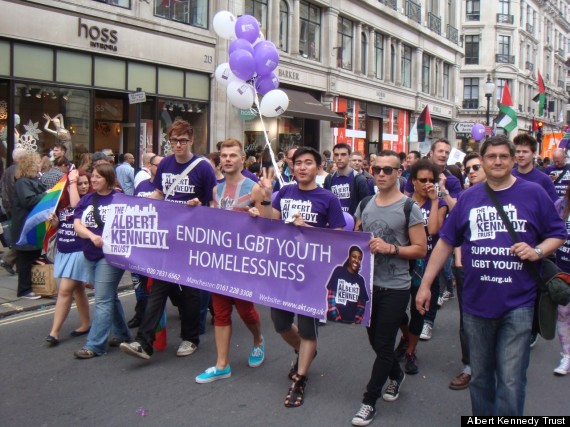
The Albert Kennedy Trust (ABK) provided 8,000 nights off the streets for young LGBT people with nowhere else to turn in 2014, a 160% increase on last year.
One teenager couldn’t return his family because of abuse. His parents, Jehovah’s Witnesses, didn’t accept his sexuality and social services initially refused to help.
“We had to employ solicitors to approach the High Court to request that he was made Ward of Court,” says Tim Sigsworth, chief executive of AKT.
But the teenager is just one example of the 1,500-plus youths who have called the AKT in need of help. More than half resulted in direct long-term case work and support.
“Two weeks into my job as CEO I met a young person at AKT who had spent one night on the streets after being rejected by his parents; during that one night he had been forced to have unprotected sex to secure a bed for the night,” Tim recalls.
“Shortly after this, his first sexual experience, he was diagnosed as HIV positive.”
The charity is named after a young man, Albert Kennedy who, whilst supported by his family, experienced homophobic abuse from strangers, which led him to take his own life in 1989.
Founded in the same year by Cath Hall, who was inspired to help young Lesbian, Gay, Bisexual and Trans (LGBT) people through her role as a foster carer, it provides accommodation, advocacy, mentoring and support for 16 to 25 year olds who are either homeless or at risk of homelessness.
The charity, which works in three cities across the UK, hears many stories from young people who have experienced homophobia, biphobia or transphobia, or ignorance of their needs from mainstream service providers.
“We also advocate for young people who have mental, physical health problems, self-harm and have substance misuse problems to obtain housing through the local authority,” Tim continues. “Sadly this is often a very long-winded process as these young people are likely to be turned away. Many young people come to us already living on the streets as their families have turned them away for coming out.”
One 19-year-old woman came to AKT after her devout Evangelical Christian parents kicked her out of her home when she came out to them as a lesbian. They also forced her to leave her child behind with them – a child conceived to cover up her sexuality. She spent the next few months sleeping in stairwells and selling her body to buy food.
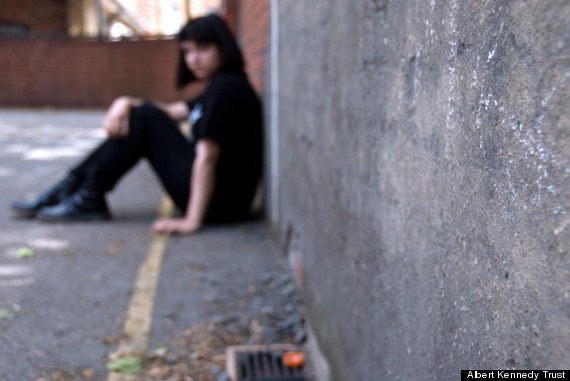
albert kennedy trust

AKT has helped 1,500 youths this year alone
AKT provided her with a room at Purple Door, a safe house, to help her rebuild her life. She is now living independently, has a job and has started a new relationship. She is also in the process of getting back her child from her parents.
According to Tim, many people underestimate the adverse impacts of homophobia have on young people – despite the recent legislative change.
“The rights of LGBT people have been greatly improved, but this has not necessarily resulted in social change. Our own work and the research of other [charities] shows that young people are coming out earlier, but more than 50% fear telling their parents. In some cases, this is founded.”
AKT has seen a “significant” increase in young people coming to the charity for help. Between July and September, the organisation saw a “shocking” 100% increase in footfall to AKT compared to the same period last year.
The charity’s own data on homelessness shows LGBT youth are three to six times more likely to attempt or complete suicide or self-harm. Previous research showsmore than half of gay youths have suffered mental health issues, with 40% considering suicide.
albert kennedy trust
AKT at London Pride
Not only are LGBT youths more susceptible to mental health issues, the impact of homelessness is far greater in terms of health and wellbeing than their peers.
“We found this included sexual exploitation, mental health issues, and physical and substance abuse,” Tim adds.
“A young man, aged 22, came to AKT after being ostracised from his community and left homeless by his family having come out as gay.
“As a result of the trauma of the situation he then lost his job and was forced to spend his time looking for places to stay – hanging around bars and clubs. One evening he went home with someone who proceeded to drug and then abuse him, along with a group of other men.
“At this point he arrived at AKT suffering from Post Traumatic Stress Disorder. As a result of the sexual abuse he suffered he had contracted HIV but had barely engaged with HIV services, as he was so traumatised. 

AKT battled the local authority, who refused to honour their duty of care to him.
“In the meantime we linked him into appropriate HIV and mental health services and provided him with a mentor to help him rebuild his self-esteem. The local authority has just housed him in his own place with our support.”
albert kennedy trust
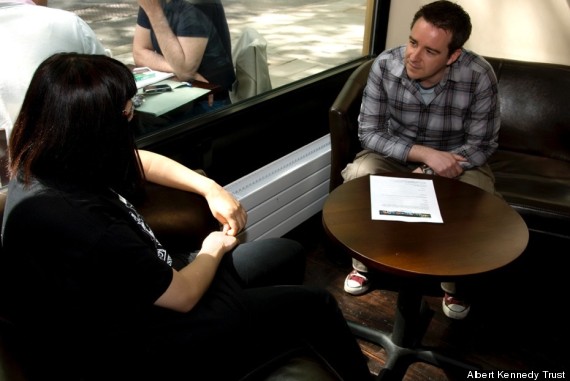
A volunteer with one of the youths AKT helps
AKT also aims to help youths rejected by their families to improve their independence skills.
“We have placements with carers for young people. They have a pathway plan that helps them achieve and improve these skills. We also have short-term accommodation available available where we house young people in an emergency, for example if they are fleeing violence or are left homeless by their families after they have found out about their sexuality or gender identity.
“Sadly we see many young people going to bars and clubs and finding people to sleep with so they have a bed for the night, which often leads to problems including sexual and drug abuse.”
AKT also helps youths plan a future. Mentors meet them on a weekly or fortnightly basis to help with practicalities such as college applications.
“We have seen a real need for this kind of support as many young people have sofa-surfed with friends and need help planning for the future. We also offer life skills training to help young people live independently.”
As for a long-term solution to the problem, Tim “absolutely” believes LGBT relationships should be taught in school.
“Many of the young LGBT people who AKT work with have experienced sexual exploitation and physical abuse in relationships and I believe this is in part due to LGBT young people not receiving education and support around same-sex relationships at school, whether on a sexual or emotional level.”

If you need help, AKT’s London, Manchester and Newcastle offices are staffed 10am – 4:30pm Mon-Fri.
London: 020 7831 6562
Manchester: 0161 228 3308
Newcastle-upon-Tyne: 0191 281 0099
If you need help at other times, call:
Shelter Housing Advice Line: 0808 800 4444 (8am-midnight every day)
LGF Helpline: 0845 330 30 30 (10am-10pm every day)
London Lesbian & Gay Switchboard: 0300 330 0630 (calls at local rate)
Samaritans: 08457 90 90 90 (24hrs)


Filed Under: Anti-Bullying & Homophobia Tagged With: Christmas, LGBT, rough, sleeping, youth

US FDA recommends ending ban on blood donations from gay and bisexual men

25/12/2014 By David McFarlane Leave a Comment

23 DECEMBER 2014

The US Food and Drug Administration (FDA) has recommended the end of a three-decade ban on blood donations from homosexual and bisexual men.

Former Northern Ireland Health Minister Edwin Poots' ban on gay men giving blood was branded 'irrational' by the High Court last year. Northern Ireland retains the ban but the region is still able to accept blood supplies from the rest of UK

Former Northern Ireland Health Minister Edwin Poots’ ban on gay men giving blood was branded ‘irrational’ by the High Court last year. Northern Ireland retains the ban but the region is still able to accept blood supplies from the rest of UK

However, some restrictions will remain, as the FDA said it favours replacing the blanket ban with a new policy barring donations from men who have had gay sex in the previous year.
Some gay activists have responded to the announcement by complaining it is unrealistic and stigmatises the LGBT community.
Having examined scientific evidence surrounding blood donation for men who have sex with men, the FDA said in a statement that it will recommend a change to the blood donor deferral period from indefinite to one year since the last sexual contact.
The current rule has been in place for 31 years and dates from the first years of the AIDS crisis, and was intended to protect the US blood supply from exposure to the little-understood disease.
Under the policy, blood donations are barred from any man who has had sex with another man at any time since 1977 — the start of the AIDS epidemic in the US.
But medical groups, including the American Medical Association, say that the policy is not supported by science, given advances in HIV testing.
Last month, a panel of blood safety experts convened by Department of Health and Human Services voted 16-2 in favour of ditching the lifetime ban, and recommended barring donors who have had male-on-male sex during the previous 12 months.

In the US, all donated blood is tested for HIV, however, the test only detects the virus after it’s been in the bloodstream about 10 days – allowing a brief window when the virus that causes AIDS can go undetected.
If the new advice is put into place, US law will be put in line with other countries including the UK (except Northern Ireland), Australia and Japan.
Patient groups that rely on a safe blood supply, including the National Hemophilia Foundation, have also voiced support for dropping the ban.
But LGBT campaigners say it does not go far enough.
“Some may believe this is a step forward, but in reality, requiring celibacy for a year is a de facto lifetime ban,” the organisation Gay Men’s Health Crisis, a New York-based nonprofit that supports AIDS prevention and care, said after the announcement.
The FDA will publish its advice in draft guidelines early next year, and will move to finalise them after taking comments from the public, officials said.
FDA Deputy Director Dr Peter Parks declined to give a deadline for the process but said, “we commit to working as quickly as possible on this issue.”
According to government figures, men who have had sex with other men represent about 2 percent of the US population, yet account for at least 62 percent of all new HIV infections in the US.
The recommendation is the culmination of a push for new policy which gained momentum in 2006, when the Red Cross, the American Association of Blood Banks, and America’s Blood Centers called the ban “medically and scientifically unwarranted.”
Belfast Telegraph:
Additional reporting by AP

Filed Under: Anti-Bullying & Homophobia Tagged With: ban, blood, donations, Ulster

  • « Previous Page
  • 1
  • …
  • 60
  • 61
  • 62
  • 63
  • 64
  • …
  • 72
  • Next Page »

Categories

Copyright ACOMSDave.com © 2026