ACOMSDave

Community Journalist

  • Home
  • Community Journalist
  • Events
  • Media Page and Press Kit
    • Projects and Work
  • Resources & Documents
    • LGBTQ+ Support Groups and Documents
  • NIGRA
  • Archives
  • Contact

Jack Andraka, at 13, provides cancer cure!

15/05/2015 By ACOMSDave Leave a Comment


GT Books


 Teenager creates a new cancer detection method

Come along to Jack Andraka’s book launch

When Jack Andraka was 13 he was being bullied for being gay, a close family friend was dying of cancer and he felt like a constant outsider.

But instead of giving up Jack used his passion for science to try and make a difference, with a brand new cancer detection system.
After conducting two years of research and being denied help from hundreds of Universities and companies, Jack’s experiment worked!
Jack’s test for pancreatic, lung and ovarian cancers now has the potential to be over four hundred times as effective as current medical solutions. And to top it off, it only costs a fraction of the price.
Breakthrough is a book that celebrates the perseverance and ingenuity of this remarkable teenager. It aims to push readers to pursue their dreams and to never stop learning.
Not only an inspirational teenage success story, Jack’s journey helped him conquer his depression and overcome bullying.
Gay’s The Word will be hosting a free book event for Breakthrough, which will take place in London on 24 May.
For more information on the event head to Facebook
Words Christopher McParlan, @chrismcparlan

Filed Under: Anti-Bullying & Homophobia, Book Reviews Tagged With: cancer, cancer cure, Jack Andraka, science

Stockport Academy Tackles Homophobia

15/05/2015 By ACOMSDave Leave a Comment

Editorial: When will homophobia be stopped in our schools in Northern Ireland.  When will Stormont and our politicians come together to fight homophobia.  We have just had an election, it will be interesting to see if they stand by the Friday Agreement on Human Rights.

The following article was republished from Gay Times

Students produce moving video in light of Anti-Homophobia Week

Students at the Stockport Academy have made a moving drama piece to coincide with Anti-Homophobia Week.
The short video is called Everybody’s Disapproval and is set to Hozier’s song Take Me To Church.
The emotive piece is shot in black and white, recreating and reinterpreting scenes from Hozier’s original video. It features both a young gay and lesbian couple being the victims of homophobic abuse.
Their short video concludes with a few statements and statistics to reinforce the overall message. “End homophobia today.”

The Academy is renowned for their zero tolerance to bullying and has previously received the Diana Award in 2014 for their campaign work in anti-bullying.
Words Tom Richardson, @tom20richardson

Filed Under: Anti-Bullying & Homophobia Tagged With: homophobia, Human Rights, politics, Stockport academy, Stormont

17 Years After Matthew Shepard’s Murder, Laramie Passes LGBT Protections

15/05/2015 By ACOMSDave Leave a Comment

The city became the first in Wyoming to adopt an LGBT-inclusive nondiscrimination law.

Reprinted from the Advoate – BY TRUDY RING

MAY 14 2015 4:45 PM ET

In 1998 gay college student Matthew Shepard as brutally beaten and left for dead on a fence like this one near Laramie.In 1998 gay college student Matthew Shepard as brutally beaten and left for dead on a fence like this one near Laramie.

The town where Matthew Shepard became the victim of a deadly antigay hate crime in 1998 — Laramie, Wyo., — has become the first municipality in the state to adopt an LGBT-inclusive antidiscrimination law.
The Laramie City Council passed the ordinance last night by a vote of 7-2, the Associated Press reports. It bans discrimination based on sexual orientation and gender identity in employment, housing, and public accommodations, and it sets up a process for filing discrimination complaints, which the city will then investigate. The ordinance will go into effect by the end of this month.
“What a day for Wyoming, and what a day for the city that became synonymous with Matthew Shepard’s murder to now step up and do this right thing,” Jeran Artery, head of the LGBT rights group Wyoming Equality, told the AP. “And I would really encourage other communities across the state to follow Laramie’s lead.”
Efforts to enact a similar law on a statewide basis have failed repeatedly, most recently inFebruary. “I’m thrilled that Laramie’s [adopting an antidiscrimination law], at the same time sort of saddened that the state of Wyoming can’t see fit to do that as well,” Judy Shepard, Matthew’s mother, told the AP. “Maybe the rest of Wyoming will understand this is about fellow human beings and not something that’s other than what they are.”
Matthew Shepard, a 21-year-old student at the University of Wyoming in Laramie, was beaten and left for dead on a fence on the outskirts of town by two men he met in a bar. He died a few days later at a hospital in Colorado. His death became a rallying point for LGBT rights activists, and federal hate-crimes law bears his name as well as that of James Byrd Jr., an African-American murdered in a racially motivated attack in Texas, also in 1998.
Judy Shepard, a longtime Wyoming resident, said her son’s murder doesn’t indicate that Wyoming residents are generally homophobic, but acting more quickly on hate-crimes law could have improved the state’s reputation. “I feel like if Wyoming had done more to open the door to acceptance, that kind of reputation would have disappeared very quickly,” she told the AP. “Instead of taking advantage of the moment, they just sort of turned around and ran.”
State Rep. Kendall Kroeker, who voted against the statewide antidiscrimination bill, objected to the crime being brought into the discussion. “The Matt Shepard case was a tragedy, but I don’t see how an antidiscrimination ordinance would have stopped somebody from committing that heinous crime,” he told the news service. Kroeker was also one of several Wyoming legislators who signed onto a brief urging the U.S. Supreme Court to reject marriage equality, claiming it would interfere with citizens’ free speech rights.
The two Laramie council members who voted against the local antidiscrimination ordinance said they worried it would interfere with religious freedom, the AP reports. “Enactment of this ordinance will result in discrimination complaints filed against business owners who are simply trying to run their business consistent with their faith,” said one of them, Joe Vitale.

Filed Under: Anti-Bullying & Homophobia Tagged With: HATE CRIMES, Matthew Shepard, politics, Wyoming

The Fred Phelps legacy: How America exports anti-LGBT poison around the world

15/05/2015 By ACOMSDave Leave a Comment

IB TimesBy Chad Griffin | IB Times – 13 hours agoWe may never see the likes of Fred Phelps and his family in the post-gay world.
  • View PhotoIB Times – We may never see the likes of Fred Phelps and his family in the post-gay world.
 

America owes the international community an apology: we are exporting our anti-LGBT activists, and they are damaging fairness, equality and human rights around the globe.

And, with support for equality on the rise from statehouses to classrooms to church pews to dinner tables – and with the US Supreme Court set to rule on marriage equality this summer – they have turned their attention elsewhere. They understand they’re losing in their own country. Americans are rejecting their vision of two Americas – one where some are equal and others are treated as second class citizens simply because of who they are.
These anti-LGBT extremists have begun exporting their hate to countries around the world, jeopardising the livelihood – and sometimes the lives – of LGBT people in places where they have no protections. Indeed, they’re opening up new battlefields overseas – working to encourage and support anti-LGBT laws in countries like Russia, Poland, Uganda and Jamaica – laws they only wish they could pass here at home.

Some of these American exporters of hate may protest this characterisation, but their true intentions are there for all the world to see. Take the World Congress of Families, for example. Since 1997, this organisation has held conferences and events around the world that foster homophobia and transphobia under the guise of protecting the “natural family.” The organisation has supported laws that marginalise LGBT people in Russia and recently honoured an individual in Nigeria who claimed LGBT advocates were conspiring with the terrorist group Boko Haram.

Every few years, the World Congress of Families hosts an international gathering of those working against the rights of the LGBT community and women. The group’s September 2014 international conference at the Kremlin was canceled due to instability in Ukraine. But later this year, many of the group’s supporters will meet in Salt Lake City, Utah. It will be the first time the World Congress of Families has ever held such a conference in the United States, despite the fact that its board of directors and staff are all Americans.
There are a disturbing cast of characters who work for, partner with, and participate in the World Congress of Families. Days after Hillary Clinton announced her candidacy for president of the United States, Don Feder, communications director for the organization, referred to Mrs. Clinton – who as secretary of state declared gays rights to be human rights – as “Hitlery,” writing that she’s too “hideous” to be president.
Partners of the organisation like Sharon Slater of Family Watch International have taken an anti-LGBT agenda to the United Nations, and advocated for marginalising LGBT people in places like Nigeria, where efforts to pass severe anti-LGBT legislation succeeded in 2014. And then there’s Scott Lively, a regular speaker at the group’s summits. Lively has promoted dangerous lies around the globe. Among other things, he’s blamed some of history’s most horrific atrocities, including the Holocaust and the Rwandan Genocide, on LGBT people.
Such rhetoric isn’t just blatantly false, it’s dangerous. In countries where homophobia and transphobia are rampant, and LGBT communities have not had the resources to combat such discrimination, the words of Don Feder, Brian Brown, or Scott Lively embolden individuals, including foreign leaders, to embrace laws that endanger LGBT people and their families. In fact, their work infects regions, not just countries where they appear. Russia’s law that prohibits public support of equality (and inspires violence), which was strongly supported by the World Congress of Families, is now bleeding into central Asia, where stronger versions of the law are moving forward in Kazakhstan and Kyrgyzstan.
That’s why we will not let these exporters of hate go unchallenged. In the words of Supreme Court Justice Louis Brandeis, sunlight is the best disinfectant, and over the last year, the Human Rights Campaign – America’s largest LGBT civil rights organization – has focused light on the anti-LGBT efforts of the World Congress of Families and other American exporters of hate. With only six months until thousands descend on Salt Lake City for the World Congress of Families’ first international conference in the US, we are releasing an updated version of Exposed: The World Congress of Families.
Some, such as Lively, are crying foul about our efforts to expose their work and have accused us of endangering them. We condemn all forms of political violence – no one, as a matter of basic human rights, should live in fear of danger. And no one should be able to hide from their own words, and the damage they do. That’s exactly why we are calling out Scott Lively’s travels from the Kremlin to Kampala – journeys taken with the express purpose of advancing laws that promote anti-LGBT sentiments. There was a time when they were proud of their anti-LGBT rhetoric and activities. If they’re ashamed of it now, they should publicly apologise. If they’re not, as public officials they should welcome the scrutiny of a fair-minded public.
Tide beginning to turn
In the United States and Western Europe, LGBT people are beginning to enjoy the civil and human rights they are rightly entitled to. Marriage equality has been law in most of the United Kingdom for more than a year and has recently been passed in Finland, Slovenia and Luxembourg. This month, voters in Ireland will go to the polls to vote for whether same-sex couples have a right to marry, a measure that is expected to pass.

‘Mister Majah P is a pioneering performer who is bravely breaking the homophobic mould of much Jamaican reggae and dancehall music. Long may he continue to assert that “One Love” includes LGBT people.’

Read Peter Tatchell’s article on the man breaking the mould of bigotry in the Caribbean here.

But as equality has spread in some parts of the world, a backwards slide has occurred in other parts. Not only are some countries further criminalising LGBT relationships and identities, but also finding clever new ways to prevent advocacy, association, and expression. Unfortunately, American fingerprints are on almost all of these efforts.
Luckily, pro-equality Americans are beginning to respond by speaking out in support of human rights and inclusion. President Obama has made LGBT rights abroad a key part of his foreign policy, with Secretary of State John Kerry recently appointing the first American diplomat devoted to advocating for protecting the human rights of LGBT people around the globe – an appointment HRC has long called for. In addition, the US has six openly gay ambassadors serving worldwide.
While the equality movement is not as organised and well-funded as our opposition at the global level, that is changing. Just as the efforts of advocates for exclusion are failing in America, their efforts will ultimately fail globally. The story of progress and prosperity is one of inclusion and love.
Hate is neither an American value nor a family value, and no American should be in the business of exporting it around the globe. And we won’t cease to expose, debunk and shine a light on those who are trying to make the case otherwise, until this despicable behavior comes to an end once and for all.

Chad Griffin is President of Human Rights Campaign, one of the world’s largest LGBT activist groups. Find him on Twitter @ChadHGriffin or the group @HRC. You can also visit the HRC websitehere.

Filed Under: Anti-Bullying & Homophobia Tagged With: Fred Phelps, hate, homophobia, murdr

Colm Tóibín: The same-sex marriage referendum and the embrace of love

15/05/2015 By ACOMSDave Leave a Comment

The campaign has allowed us to set out how we wish to be treated

Colm Toibin: ‘We seek to embrace marriage and strengthen the idea of the family and our involvement in it. We seek to enhance the institution of marriage. We want to make the same vows as others do, for the same reasons.’ Photograph: Bryan O’Brien

Reprinted from the Irish Times

Colm Toibin

First published:Thu, May 14, 2015, 16:14

In 1996, after I had published my novel The Story of the Night, which is in part an account of the love between two men, I received a private letter from one of the most powerful men in Ireland, someone who had served in government, and was then and later a figure of immense influence in public life. I had never met this man, and I was surprised by the tone of the letter that was personal but also engaged, almost urgent. He simply said that it had never occurred to him that two men could fall in love in the way straight people do, that a man could wait for phone calls and messages from the loved one who was also a man, or that the two men could begin to long for and enjoy each other’s company and thus become happy in the warm glow of love. He had thought being gay was merely about sex, that it was a merely sexual orientation, that its embrace did not include what the novelist Kate O’Brien called “the embrace of love”.

A few weeks later I met a prominent Irish feminist, someone had been at the forefront of the women’s movement, and she too expressed surprise at the intensity of the relationship between the two men in the book. “They sound like straight people,” she said. I told her that that was because they were like straight people, that they wanted intimacy and love, they wanted each other, they wanted ease in their domestic and family lives. They also wanted their relationship to be publicly recognised. They wanted to move out of the shadows and into the light.

I was concerned that these two educated, decent and liberal people could know so little about homosexuality. What I viewed as normal, they viewed as strange. What I viewed as an essential part of my life, they viewed as something they knew nothing about. It struck me that they must, along the way, have worked with gay people; they probably had neighbours who were gay, they may have even had family who were gay, but in Ireland until recently gay people had a way of living in the shadows, not declaring ourselves. We had a sort of secret city – bars and discoes, bath houses, websites, places of assignation – and some of us had become skilled at moving between these places as though we were invisible. Invisibility became part of a survival mechanism.

The downside of that was that people simply did not know about us, and more importantly, did not know that our way of loving has precisely the same contours and textures as anyone else’s, the same fears and intensities, the same needs and comforts. One of those needs includes the need for the same rituals and the same constitutional protection as other people have and enjoy.

Other communities who have been oppressed – Jewish people, say, or Catholics in Northern Ireland – have every opportunity to work out the implications of their oppression in their early lives. They hear the stories; they have the books around them. As gay people, on the other hand, we grow up alone; there is no history. There are no ballads about the wrongs of the gay past, the gay martyrs are mostly forgotten. It is as though, in Adrienne Rich’s phrase, if you were gay, “you looked into the mirror and saw nothing”. Thus the discovery of a history and a tradition and a sense of heritage must be done by each individual, as though alone, as part of the road to freedom, or at least knowledge.

This is maybe why this same-sex marriage referendum campaign, the one we are going through now, has been so liberating for gay people and for our friends and families. It has allowed us to set out publicly and communally who we are and how we wish to be treated in our country in the future. It has allowed us to have a public debate with our entire nation about our need for recognition and equality. It has allowed us to speak openly about the terms of our love. The level of support has been heartening, encouraging, inspiring. After 2015, it is unlikely that there will be many people in Ireland who will not know about us, have a sense of how ordinary our desires are. Or see how normal and middle-of-the-road most of us are.

As of now, we have, it seems, no wish to question marriage as an institution, or undermine the centrality of the family under the Irish Constitution; instead we seek to embrace marriage and strengthen the idea of the family and our involvement in it. We seek to enhance the institution of marriage. We want to make the same vows as others do, for the same reasons. We want to live in the ease and with the protection which marriage offers. It is not hard to see how much happiness and relief this will bring to us and to our families; it is, however, hard also to see how this will adversely affect other people who already enjoy the benefits of marriage, the majority of whom will, we hope, be generous enough to want to allow us to share what they already have. What we want is strangely simple: we want to be included. Winning the right to marry on May 22nd will lift a great weight from us and those who wish us well; it will be a liberation for us, and a milestone in the history of increasing tolerance in Ireland.

In 1941 the Irish novelist Kate O’Brien published The Land of Spices, which is one of her best novels, and one of the greatest novel ever written about the religious life. Towards the end of the third chapter, the young Helen Archer, who will later become a Reverend Mother, comes home unexpectedly from school in Brussels and saw her father and another man “in the embrace of love”.

This single image, the only reference to homosexuality in the book, is all the more explosive and dynamic because of that. For those four words “the embrace of love”, the book was banned by the Irish Censorship Board.

They are the very words now that, in this campaign, animate us and nourish us. Because we are not talking about abstract rights, abstract discrimination. We are not even talking about sexuality. Rather, we are talking about love, about the embrace of love, about how our love equals the love of our fellow citizens who are heterosexual, and how right and necessary it seems to us, indeed how much of an imperative, that our love should be ritualised and copper-fastened and celebrated in marriage in the same way as everybody else’s love. If there is someone who believes that our love is of a lesser order than theirs, how can they know this? Who have they asked?

Kate O’Brien, who was a great stylist, was also a writer with a keen, brittle mind and a sharp eye. A tremendous maker of phrases, she mixed irony and sympathy in equal measure. As we come up to voting day, it seems fitting to invoke her great old spirit. Helen’s father and the man in The Land of Spices were not merely embracing, but they were “in the embrace of love”. That is what the girl saw, and it was perhaps that idea which so disturbed the Censorship Board, the idea that there was someone not willing to caricature sexual relations between men, but rather offer them dignity and suggestiveness, and then bring in the word, the word that should dominate out thinking and our argument over the next week. The word is love, our love. That is what matters to us most now as equality comes close.

This article is an abridged version of a public talk given by Colm Tóibín in Trinity College Dublin focusing on same-sex relationships and literature entitled ‘The Embrace of Love: Being Gay in Ireland Now’ on Thursday, May 14th, 2015.

Filed Under: Anti-Bullying & Homophobia Tagged With: colm toibin, Irish politics, marriage equality

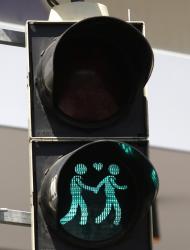
Vienna turns on the gay lights ahead of Eurovision

13/05/2015 By ACOMSDave Leave a Comment

  • Austria gets into the Eurovision spirit with its gay-themed traffic lights across ViennaView PhotoAustria gets into the Eurovision spirit with its gay-themed traffic lights across …
  • Officials say the revamped signals are signs of Vienna's tolerance, as well as part of an experiement to raise traffic awarenessView PhotoOfficials say the revamped signals are signs of Vienna’s tolerance, as well as …
  • The installations are also to promote Austria's Eurovision entry, "I Am Yours" by The MakemakesView PhotoThe installations are also to promote Austria’s Eurovision entry, “I Am …
  • View Photo

From gay-themed traffic lights to singing sewers, Vienna is getting spruced up as it prepares to host one of the world’s most popular music competitions, the 60th Eurovision Song Contest.

With less than a week to go before the first semi-final, the Austrian capital has launched a series of original initiatives to celebrate the ESC’s anniversary edition.
Lights at 120 pedestrian crossings are receiving a quirky makeover: instead of the traditional single figure, they now show either a heterosexual or gay couple with hearts.
Officials said the revamped signals were signs of Vienna’s tolerance, celebrating not only the song contest, but also the HIV/AIDS charity Life Ball event on May 16 and the Rainbow Parade in June.
The installations are also part of a scientific experiment aimed at raising traffic awareness.
Local authorities said the signals had been replaced at junctions where people traditionally ignore the red lights, and want to test whether the new interfaces can change the public’s behaviour.
However, not everyone likes the campaign.
Toni Mahdalik of the right-wing FPO party called the initiative gender politics “gone mad”, and said the money would have been better spent on reducing poverty and unemployment figures.
Back on Vienna’s busy high streets and squares, sewers have swapped gurgling sounds for musical tunes.
Cleverly hidden stereo systems inside the gutters play Austria’s two winning Eurovision songs — one by bearded drag queen Conchita Wurst, who won last year, the other by 1966 champion Udo Juergens.
They also promote this year’s entry, “I Am Yours” by Austrian trio The Makemakes, currently ranked 21st of the bookmakers’ favourites.
Austria is one of 40 nations taking part in the competition.
After the semi-finals on May 19 and 21, the remaining 27 countries — including first-time contestant Australia which has automatically qualified — will face off in the grand finale on May 23.

Overall, the contest is estimated to cost between 25 million euros ($28 million)and 27 million euros, according to Austrian public broadcaster ORF, which is organising the event.

Filed Under: Anti-Bullying & Homophobia Tagged With: couples, Eurovision, traffic lights, Vienna

Gay New Jersey high school wrestling state champ comes out on college recruiting trip

13/05/2015 By ACOMSDave Leave a Comment

Large outsports.com.full.27780 SB Nation Outsports – By Cyd Zeigler  @CydZeigler on May 11, 2015, 9:28a 46

New Jersey state wrestling champ Alec Donovan, a top college recruit, is sharing his truth with the world.

Gay high school wrestling champion Alec Donovan wants colleges recruiting him to know he’s gay. He hopes sharing his story will help other LGBT athletes struggling with who they are.

It was on a recruiting trip to Limestone College in South Carolina that Alec Donovan finally answered “the question.” Donovan had just won the New Jersey high school state championship in the 145-pound division of the NJSIAA/Rothman Institute Wrestling Championships. Along with him on the recruiting trip was another New Jersey wrestler who had placed in the state tournament.

“Rumor is you’re bisexual,” the other recruit said to him. “Is it true?”

It had been a long journey for Donovan, once fraught with fear, depression and suicidal thoughts since realizing he was gay as a high school freshman. Now a senior approaching graduation, he had climbed out of the abyss all the way to a state title and a peace of mind. There were a select few close to him who knew his secret, but he had never shared it with other top wrestlers.

“The rumor isn’t true,” Donovan told the other recruit. “I’m not bisexual… I’m gay.”

The recruit was “cool with it” and found it fascinating. He asked Donovan if he could tell the guys on the Limestone team who were recruiting them. Donovan didn’t care. He had accepted who he was. Fear had left him.

“It’s better that everybody knows anyway, so I don’t end up on a team that doesn’t want me for all of me.”

When the other wrestlers at Limestone College heard the news, they were hardly fazed.

“That’s cool as long as you don’t hit on me” was the worst reaction Donovan received from the Limestone grapplers.

“Why would I hit on you?” Donovan replied, happy to not face rejection. They laughed.

A state champion, Donovan was 39-1 in his senior season and ranked in the top 25 in the entire country for his weight class. The Limestone College wrestlers just wanted a good competitor to join their team. Donovan has stayed in touch with the captain of the team, and Limestone is one of Donovan’s top choices for college. His sexual orientation is largely irrelevant to today’s college athletes focused on excellence and victory.

Yet Donovan does not know where he will compete next year. At the time this story is published, Donovan is on a recruiting trip at Cal Poly in San Luis Obispo, halfway between Los Angeles and San Francisco. Other schools – in addition to Limestone College – have come calling as well.

For Donovan, the importance of being with a program that wants him for who he is – and the opportunity to help other LGBT athletes walking down the path he was on just three years ago – far outweighs any risk this story might pose.

*  *  *

During his freshman year at Brick Memorial High School, Donovan was plotting to kill himself.

Growing up in Brick, N.J., just over an hour outside of New York City and Philadelphia, he had heard anti-gay language in school, in sports and from friends and family all his life. Better to end that life than live it as a gay person, he had decided.

“I felt like I was a piece of dirt. I was worthless.”

Worthless. This eventual state champion and top college recruit felt worthless three years ago simply because of his sexual orientation. Think about that. The environment in the United States – in and outside of sports – continues to drive talented, promising young men and women to suicidal thoughts, feeling as though the world is better served without them in it.

Donovan even wrote a suicide note. Thankfully it was the middle of wrestling season, and he felt an inexplicably loyal obligation to his team to finish the season with them. Despite early success, the season didn’t end well. He missed weight at his regional meet by ounces and was barred from competition. His coach screamed at him. He was depressed, desperate for answers. He had let his coach down and he was… different.

He hit rock bottom.

In that time he researched suicide and the reactions to it. As he watched YouTube videos and read blogs chronicling the aftermath of suicide, Donovan became more and more present with his will to

At the end of his freshman wrestling season he reached out to a friend, Haley, for help. He was struggling with his sexual orientation and didn’t know where to turn. Haley was the perfect sounding board. She convinced him to tear up the suicide note he had written to his parents – she stood and watched as he did it.

“I was so happy she made me do that. Because now I don’t think about it. I’m moving forward.”

*  *  *

During a road trip to Atlantic city his junior year, two teammates cornered him. On these road trips it was four guys to a hotel room. While one of his roommates was in the shower, the other two pressured Donovan into answering the last question he ever wanted to hear.

“I know we’re brothers,” said one of the teammates, “but are you gay?”

Donovan surveyed the hotel room carefully. He was nearer to the door than they were. He wanted to tell them the truth, but if they tried to attack him he needed an escape plan – that was the level of fear he faced. As he had been told all of his life, gay athletes would not be welcome on a sports team, let alone in a sport with athletes competing in the close quarters of wrestling. This could go very badly.

“Yes,” Donovan told them, “I’m gay.”

He braced himself for an attack that would never come.

“I’m proud of you,” one of his teammates said. “We’re brothers and, no matter what, brothers stick together.”

The acceptance of those two teammates meant the world to him. He had for years feared how his peers would perceive him, whether they would reject him on the mat. Donovan (left, in the grey sweatshirt) had been channeling his will to live into wrestling. He wanted nothing more than to be the best wrestler he could possibly be – he wanted to be a state champion.

The acceptance of his teammates translated into renewed dedication to his sport. If he could accept himself, and if his teammates could accept him, then he could go as far as he chose to go.

*  *  *

Now a state champion, Donovan is a top college wrestling recruit. He has been ranked in the top 25 of high school wrestlers in his weight class in the nation. He lost one match out of 40 last season. And he’s gay.

In the next 10 days he will decide for which college he will wrestle. With this public revelation, each school that has recruited him or offered him a scholarship has the opportunity to showcase inclusion. The next 10 days will be telling.

Whatever happens, Donovan knows he will be competing as a publicly out gay NCAA wrestler in the 2015-16 collegiate season. Unless someone else comes out in the sport in the next six months, he will be the first person to do so.

Yet his significance off the mat makes him just as enthusiastic. From the first time we communicated months ago, Donovan badly wanted to help other people by sharing his story publicly. The wins and the losses are great, and they lend heft to his story. Helping other people excites him.

Every time we have spoken, Donovan has mentioned a clandestine anti-bullying group he has been part of at Brick Memorial High School. Beating down his opponent in the ring is his trade, his lifelong passion. It has earned him college scholarships. It has brought him incredible glory in the form of a state championship. Yet tackling bullying and intimidation are what drive him more than success on the mat.

“I’ve done a lot of great things ever since I was suicidal,” Donovan said. “But yeah, helping other people makes me most proud.”

You can follow Alec on Twitter @thedoc42007. You can reach him via email at alecthedoc@hotmail.com.

If you’re a teen struggling with depression or thoughts of self-harm, please contact The Trevor Project immediately. Someone is there to help you.

Alec Donovan


Gay wrestler at Don Bosco in Iowa wrote his dad & coach a letter. The response was great.

Gay wrestler at Don Bosco in Iowa wrote his dad & coach a letter. The response was great.


Outsports male hero of the year: Conner Mertens

Outsports male hero of the year: Conner Mertens


GO! Athletes logo

Filed Under: Anti-Bullying & Homophobia

Straight Bodybuilders Take a Really Muscular Stand Against Bullying

13/05/2015 By ACOMSDave 1 Comment

From OUT magazine

BY LES FABIAN BRATHWAITE
MAY 11 2015 4:37 PM EDT
bodybuilders_v_bullying

They’re going to pump you up. Your self-esteem anyway.
BY LES FABIAN BRATHWAITE
MAY 11 2015 4:37 PM EDT
1.9K41
YouTube gays Davey Wavey and Raymond Braun asked straight bodybuilders about bullying and — besides an excuse to have more slabs of beef than your neighborhood Sizzler — these mammoth muscle men reveal that their hearts as big as their biceps. Which, for the record, are friggin’ huge.

1
2
3

Most of them were bullied at some point in their lives, including Brad Rowe (this guy):

4

who actually has a gay dad and was bullied as a result, despite being an “alpha male.” Check out his and other stories in the video below. Meanwhile, why everyone’s wearing a shirt is beyond me, but that’s neither here nor there.

And here’s part two, featuring some commentary and background from Davey and Raymond.
Les Fabian Brathwaite — do you even gif, bro?

Filed Under: Anti-Bullying & Homophobia Tagged With: bully, straight bodybuilders

Marriage referendum debated live on UTV Ireland

13/05/2015 By ACOMSDave Leave a Comment

IRELAND LIVE 11 MAY 2015 Story by UTV Ireland Staff, Dublin

Representatives of both sides of the marriage referendum coin discussed the issues live on UTV Ireland on Monday in the first of a series of referendum debates this month.

Marriage referendum debate one

Videos (3)

Marriage referendum debate one

09.03

Marriage referendum debate one

Marriage referendum debate two

08.58

Marriage referendum debate two

Gay community divided over marriage referendum

02.33

Gay community divided over marriage referendum

News anchor Alison Comyn explored both Yes and No vote arguments from representatives of Mothers and Fathers Matter, Yes Equality, Stand Up for Marriage and Labour LGBT from UTV Ireland’s Cork studios on Monday.
On May 22, the electorate will be asked to vote on the proposal to add a new clause to Article 41 of the Constitution: “Marriage may be contracted in accordance with law by two persons without distinction as to their sex.”

Mothers and Fathers Matter spokesperson Margaret Hickey and Stand Up for Marriage chairman Barry Jones represented the No side on Monday’s debate.
Ms Hickey said: “Marriage in Article 41 is described as the foundation on which the family is structured, so if you change the definition of marriage which you are doing in a very fundamental way by taking it from a gender-based instruction to a gender-less institution, you are going to obviously profoundly change the constitutional understanding of parenting and family.”
Mr Jones added: “If it does go through, what will happen is that the definition of marriage will be changed and if that is changed, because of the way the Constitution is written, then family will be changed.
“The definition of family, or what it means, will be changed and if it is changed that means the fundamental building block of society, society will change but if it changes artificially it has to give rise to trouble,” he added.

Yes Equality’s Joe Noonan and Catherine Clancy from the Labour Party’s LGBT group were proposing a Yes vote.
Mr Noonan said: “Civil partnership is something that is understood by family lawyers. Marriage is understood by everybody and everybody should be entitled to marry subject to the law and that is what we are voting on.”
Ms Clancy added: “This referendum is a one liner and all you are being asked is do you agree that same sex couples can marry. In Ireland alone we have 220,000 gay or lesbian citizens – the population of cork is 120,000 people – so that is near double the population of Cork city.
“What we are saying is on May 22 to go out and give those 220,000 people, if they wish, the right to marry the same as you or me and anybody else and to have that recognition for their relationship.”
Meanwhile, former Cork Hurler Conor Cusack said a Yes vote would send out an important message.
“I just think that we had the decriminalisation of homosexuality some years ago and I think this referendum is another stepping stone on that long road to equality, because it is not about wanting to be treated as less than or more than anyone else. It is about wanting to be treated equally,” he said.

In recent years, both Conor and his brother Donal Óg came out as gay.
“I know for people out there there is a load of fear and worry around this but ultimately what this comes down to is the things that bind us all as human beings. It is a desire to be loved and to be able to love,” Conor added.
However, First Families First argue that a Yes vote will radically change the legal meaning of family and parenthood. Their concerns centre on the wording of the referendum.
“Judges can only work with what they are being given and what they are being given is a complete change in the landscape of family law which is going to result with sadness. It is going to play out in a lot of tragedy for children and for their biological parents in the future,” said First Families First representative Kathy Sinnott.
Two gay couples also told UTV Ireland about their differing views on the upcoming referendum.
Paul Dalton, who entered into a civil partnership with his partner Des two years ago, said he is still unsure what to call his other half, which he says makes his relationship feel less important.
“For a lot of people, introducing him as my civil partner doesn’t make any sense. That language doesn’t translate. Not being able to introduce Des as my husband is very strange and very limiting.
“Our relationship is different and inferior. My father said recently, ‘when this is passed will your civil partnership be upgraded?’ He is 78 years old. He didn’t really knows what he was saying but I think it captures it,” explained Paul.
However, Keith Mills who is about to celebrate a one year anniversary with his partner, has a completely different opinion on the referendum and will be voting no.
“Ireland has transformed completely in the past number of years. We have gay ministers, business leaders, sportsmen, journalists, judges and it is terrific and we don’t need gay marriage.
“We have to think of the issue of surrogacy – giving same sex couples the right to marriage gives them the right to surrogacy. I look at the situation like Elton John and his partner bringing children into the world and excluding the mother and I’m very uncomfortable with that.
“I hope that the referendum fails and I will then campaign to put civil partnerships on an equal standing with the constitution so we have that diversity recognised forever and ever,” said Keith.
Monday’s discussion will be followed by a live debates on the Age of Presidential Candidates Referendum in Dublin on 12 May and in Galway on 18 May.

The series of referendum debates will cumulate with a final debate on the Marriage Referendum in UTV Ireland’s Dublin studio on 19 May.
UTV Ireland’s Referendum Debate Schedule:
11 May: Marriage Referendum Debate
Broadcast live from Cork on Ireland Live at 10pm
12 May: Age of Presidential Candidates Referendum Debate
Broadcast live from Dublin on Ireland Live at 10pm
18 May: Age of Presidential Candidates Referendum Debate
Broadcast live from Galway on Ireland Live at 10pm
19 May: Marriage Referendum Debate
Broadcast live from Dublin on Ireland Live at 10pm
23 May: Regular updates from the Ireland Live News team throughout the day, with a special edition of Ireland Live at 5.30pm

Filed Under: Anti-Bullying & Homophobia Tagged With: Ireland, Irish politics, marriage equality, marriage referendum, Southern Ireland

A local councillor has called for the removal of the LGBT pride flag from Cork City Hall

13/05/2015 By ACOMSDave Leave a Comment

Reprinted from TheJournal.ieBy Cianan Brennan | TheJournal.ie – 22 hours agoA local councillor has called for the removal of the LGBT pride flag from Cork City Hall

  • View PhotoTheJournal.ie – A local councillor has called for the removal of the LGBT pride flag from Cork City Hall

A row has broken out at a meeting of Cork City Council over 22 May’s same-sex marriage referendum.

Fianna Fáil councillor Terry Shannon has called on council chief executive Ann Doherty to remove the LGBT rainbow flag which is currently flying from the roof of Cork City Hall.
Shannon says that it’s inappropriate to have such a flag flying with the referendum due to take place on 22 May.
As an alternative, Shannon suggested that if the pride flag must fly then a No flag must also be displayed at civic buildings.

shannon

The flag is being flown to mark the Cork’s fifth annual LGBT Awareness Week.
“I believe, as a corporate body, we should not have a flag like that hanging over City Hall while the referendum is on.  Either we put up two flags or we take this one down,” Shannon told the Irish Examiner after the council meeting where he raised his concerns.

Filed Under: Anti-Bullying & Homophobia Tagged With: cork, councillor, LGBT, LGBT flag, Pride flat, Terry Shannon

  • « Previous Page
  • 1
  • …
  • 43
  • 44
  • 45
  • 46
  • 47
  • …
  • 72
  • Next Page »

Categories

Copyright ACOMSDave.com © 2026