ACOMSDave

Community Journalist

  • Home
  • Community Journalist
  • Events
  • Media Page and Press Kit
    • Projects and Work
  • Resources & Documents
    • LGBTQ+ Support Groups and Documents
  • NIGRA
  • Archives
  • Contact

Coming Out Cards

11/07/2015 By ACOMSDave Leave a Comment

‘Coming Out Cards’ Provide The Perfect Response For A Newly Out Loved One

The Huffington Post  |  By JamesMichael Nichols
Posted: 07/09/2015 2:00 pm EDT
Coming out is never easy.
However, for individuals who have never loved or been close to a member of the lesbian, gay, bisexual or transgender (LGBT) community, knowing how to respond to someone’s coming out can also be challenging.
For this reason, queer teen John Hansen began making “Coming Out Cards” — free eCards that can be sent to a newly out member of the LGBT community as a small gesture of support and compassion. The cards are often tongue-in-cheek, adding a lighthearted air to what can be one of the most difficult times of a queer person’s life.
“Coming out is often isolating, and continuing a dialogue with someone who has recently come out can make them feel much more comfortable and confident,” Hansen told The Huffington Post. “It can make such a huge difference to remind them that you’re listening, that you understand and that you’re there for them. I hope these eCards will do exactly that.”
The Huffington Post chatted further with Hansen this week about the “Coming Out Cards” and the impact he hopes they achieve. Check out the interview, as well as the cards themselves, below.
Coming Out-2Coming OUt-1

Why did you decide to create these “Coming Out Cards”?
John Hansen: For a while now, I’ve noticed that there are greeting cards for almost every occasion, yet very few geared specifically towards coming out. And so, about a month ago, I decided to change that. Because I’m not much of a designer, a big part of the eCards for me has always been the message — I wanted the cards to feel fun and positive and conversational all at once, so that they’d read like a friend’s dorky text.
Why do you think this resource is so important for the queer community?
The eCards certainly won’t change everything — one of the many pressing issues facing the queer community is acceptance, and it’s brave LGBTQIA+ people across the world who are fighting to make acceptance the norm. But my hope is that these cards will help in that “after coming out” stage, both by putting a smile on a queer person’s face and by letting them breathe deeply because they know they truly are supported.
Coming Out-5Coming Out-4Coming Out-3
In your opinion, why are affirmations of support crucial to the healthy lives of queer people?
Though not every queer person will need an affirmation of support, I do think that — especially in the beginning stages of the process — many people are still deeply uncertain about how their sexuality or gender will affect their relationships, and little affirmations of support can help remind them that it’s going to be okay. Coming out is often isolating, and continuing a dialogue with someone who has recently come out can make them feel much more comfortable and confident. You honestly don’t know what’s going through their mind — they might still be insecure about their sexuality or gender, for example, or they might have had bad coming out experiences in the past and are worried that this one will also turn sour. It can make such a huge difference to remind them that you’re listening, that you understand and that you’re there for them. I hope these eCards will do exactly that.
What do you hope to see from this project in the future?
I’d really love for the cards to reach the right people — by which I mean queer people who might find them funny, yeah, but also others who are supportive of the LGBTQIA+ community but who aren’t quite sure how to express it. I hope these cards will bridge the gap for anyone who is struggling to convey their admiration for a loved one who has recently come out.
Want to see more “Coming Out Cards”? Head here.

Let Us KnowEditorial:  Do you think you would ever use a Coming Out Card?  Have you already used a Coming Out Card?  Write and let us know.

Some Celebrities Who Have Come Out As LGBT

Matt Bomer 2012Gillian Anderson 2012Jodie Foster 2013Wentworth MIller 2013
 

Filed Under: Anti-Bullying & Homophobia Tagged With: coming out, Coming Out Cards, equality, Gillian Anderson, Jodie Foster, Matt Bomer, Wentworth Miller

LGBT Groups Welcome Employment Protection For Gay Teachers

11/07/2015 By ACOMSDave Leave a Comment

outmost_logo

The Government yesterday passed through a report stage bill that will amend Section 37.1 of the Employment Equality Act.

The amendment will allow employees working in religious run organisations, such as schools and hospitals, to be open about their sexuality without fear of dismissal.
INTO LGBT Teachers’ Group welcome the amendment, saying that the change will have a hugely positive effect on teachers.

Speaking outside the Seanad, Chairperson of the INTO LGBT Teachers’ Group Anne Marie Lillis commented, “LGB teachers can be secure in the knowledge that speaking about our families and our relationships, in the same way as our colleagues and that being gay or lesbian will have no bearing on job security or on prospects for promotion. When signed into law this legislation will end the threat of discrimination in primary schools based on sexual orientation.”

Sheila Nunan General Secretary of the INTO added, “The INTO has always advocated for the equal treatment of our members and to remove the weight of discrimination being felt on the grounds of sexual orientation. These amendments will further that aim and ensure that the lives of our teaching colleagues significantly improve. It is a victory for all teachers in our classrooms throughout the country. This is the culmination of the hard work our members of the LGBT Teachers’ Group have done over many years”.

The Bill has to still pass the final stage before being introduced into law. The INTO LGBT Teachers’ Group acknowledged the work of Senator Ivana Bacik, Minister Aodhán O Ríordáin, Senator Averil Power and Senator Katherine Zappone who worked in progressing the Bill.

Filed Under: Anti-Bullying & Homophobia Tagged With: Employment Law, equality, Gay Teachers, Irish politics

How the internet is helping homeless LGBT youth

10/07/2015 By ACOMSDave Leave a Comment

LGBT Youth-1
 
A new video, created by Vocativ, shows the impact that the internet can have in helping LGBT young people who have been made homeless in the US.
The short video highlights the stories of a number of residents at the Lost-N-Found shelter in Atlanta, Georgia.
 
LGBT Youth-SpencerOne of the residents – Matthew – speaks of being thrown out of his home by his preacher father, while trans man Spencer was also ostracised by his religious family.
Matthew recounts how helpful the internet was in helping him find somewhere to go: “I was able to get online and just find… That one chance, that one opportunity. My phone really saved my life.”
The shelter was opened in 2011 by Rick Westbrook, who says that: “social media is wonderful” for those who find themselves without a home.
However, Westbrook also notes the dangers of the internet for vulnerable LGBT youth: “[social media] is also a gateway for a lot of the people that prey on our youth. We have a lot of creeps out there.”
Watch the video below:
 

Further information about Lost-N-Found can be found here.
Words Ross Semple, @rosssemple
Images Voactiv

Filed Under: Anti-Bullying & Homophobia Tagged With: Gay Times, LGBT youth, LGBT Youth and the Internet, Lost-N-Found

100 years on, we can still honour Casement’s wish

10/07/2015 By ACOMSDave 1 Comment

Martina Devlin

Irish Independent 

9 July 2015

Portrait of Irish patriot, Sir Roger Casement, 1864-1916. GettyJuly 1916. The days were ticking closer to Roger Casement’s execution on a charge of high treason. By now, he was publicly vilified in Britain not just as a revolutionary but as a homosexual, stripped of the knighthood he had earned as a human rights campaigner.

In his cell, his thoughts turned to the haunting majesty of the Glens of Antrim, scene of his boyhood, and he expressed a longing to be buried there.

That desire remains unfulfilled. As commemorations to mark the Easter Rising’s centenary begin on August 1 with a year-long series of events, it’s appropriate to re-open the matter of Casement’s dying wish. Now is the time to make a respectful request on his behalf to the Belfast and London governments.
Let me take you back to those final days in London’s Pentonville Prison. His appeal against conviction was rejected on July 18, and he began writing farewell letters. One of the most poignant went to his cousin, Elizabeth Bannister. “Don’t let my body lie here – get me back to the green hill by Murlough – by the McGarry’s (sic) house looking down on the Moyle – that’s where I’d like to be now and that’s where I’d like to lie.”
Paper was scarce for condemned prisoners, and his writing became progressively smaller as he tried to cram in everything he wanted to say. “God bless you and keep you my dearest, dearest one. You and G. (Gertude, another cousin) have been the best things in my life these awful days… And so au revoir.” He signed it Roddie.
The letter is dated July 25, 1916. Nine days later he was hanged.
His request was ignored. Instead, his body was buried in an unmarked grave in the prison yard. It was treated with contempt, thrown naked into an open grave without a coffin, and covered with quicklime. The quicklime was standard but the rest was not common practice, and showed how he was viewed by the British authorities in whose eyes the former diplomat had betrayed class and country.
Yesterday, I walked by the house where Casement was born in the Dublin suburb of Sandycove, a few minutes from where I live. I pass there regularly, always turning my thoughts towards this cultivated individual whose privileges did not blind him to the human rights abuses heaped on the voiceless and powerless.
He was a combination of North and South, raised by relatives in the Ballymena area after his parents’ death. How fitting it would be now for North and South to join together in a spirit of friendship, showing respect for a public-spirited countryman who campaigned with compassion and conviction against slavery in the Congo and Peru.
Ultimately, Britain treated his remains with respect. But still his bones lie other than where he asked. In 1965, following decades of petitioning, Casement’s grave was opened and he was removed from under the skeletons of two hanged murderers.
Ireland received his body but with conditions attached: he could not be buried north of the border in case either loyalist or nationalist sentiments were stirred. And so today he rests in the Republican plot in Dublin’s Glasnevin.
Surely, after so long, people can be encouraged to see Casement in his totality. A British consul by profession, he became an anti-imperialist, but above all else he was a humanitarian.
He considered Antrim to be his home, and memories of Murlough Bay – an area of outstanding beauty with views across to the Mull of Kintyre – appear to have afforded him some respite as his death approached.
It is a matter for regret that almost a century after he was executed, there is no prospect of his wishes being honoured. Perhaps some might contend that his bones have been disturbed enough. In which case, I suggest a memorial in Murlough Bay.
It could symbolise the reconciliation between North and South after too many decades of mutual misunderstanding.
The McCarry family mentioned in that letter, with a minor misspelling of their name, erected a stone Celtic cross to pay tribute to him in 1928. Sadly, it was vandalised repeatedly by sectarian groups and was finally blown up. But must extremist views hold sway?
Casement represents a number of the multiple strands entwined through this island’s shared history: son of a Northern military father and Southern mother; born Anglican and a convert to Catholicism immediately before facing the hangman; a British Consul knighted for his services to the Crown who became a 1916 revolutionary.
In those July days 99 years ago, supporters lobbied for his sentence to be commuted, even as Casement’s private diaries describing homosexual encounters were circulated – a cynical move to undermine calls for clemency. Arthur Conan Doyle, WB Yeats, George Bernard Shaw and the US Senate made representations on his behalf. It did not change the outcome.
And what difference, you may wonder, would heeding his dying wish make after so much time has elapsed? Quite simply, it’s the right thing to do. It attaches value to his humanitarian record, which stands apart from his republican aims.
Despite the pomp and ceremony of his state funeral, with throngs filing past his coffin and an oration from President Eamon de Valera, what Casement longed for was simpler.
As he finalised his affairs, the remote beauty of the Antrim coast he knew as a boy called to him. He called to it in return – must that cry continue to go unheeded?

Irish Independent


Filed Under: Anti-Bullying & Homophobia, History Tagged With: Irish History, Irish politics, lgbt history, roger casement

Sainsbury’s Cover-up

10/07/2015 By ACOMSDave Leave a Comment

Sainsbury’s criticised for placing ‘modesty cover’ over gay lifestyle magazine but not FHM

Siam Goorwich for Metro.co.ukThursday 9 Jul 2015 12:32 pm
Sainsbury Cover-up
Sainsbury’s have been criticised for placing a copy of gay lifestyle magazine Attitude magazine behind a modesty cover, whilst making no effort to conceal FHM.
This apparent bias was highlighted when twitter user Jon Rowles tweeted a picture of the magazine rack in Sainsbury’s Mid City Place branch in Holborn, London, along with the comment, ‘Why I don’t shop @sainsburys anymore. Naked women OK but @AttitudeMag Pride Hero’s cover indecent.’
Furthermore, whilst the FHM cover in question features a bikini-clad woman, everyone on the cover of August’s Attitude magazine (which happens to be their Pride Heroes edition) is fully clothed.
attitude_mag_cover
 
 
Talking to Pink News, Mr Rowles explained: ‘What struck me was how it made the publication look seedy and somehow shameful, like I had walked into a timewarp and gone back to the early 1990s.’
Metro.co.uk contacted Sainsbury’s for a comment, and a spokesperson told us: ‘We have previously contacted the distributor of Attitude magazine with a view to remove the modesty cover on this title. The distributor agreed that whilst the cover of this magazine is now generally suitable for display, there could be future issues where it may not be. This is something we regularly review along with taking guidance from the Professional Publishers Association.’
They also explained that on this occasion FHM has been placed on a lower shelf by mistake, and that it should be displayed further back where the cover is less visible
Read more: http://metro.co.uk/2015/07/09/sainsburys-criticised-for-placing-modesty-cover-over-gay-lifestyle-magazine-but-not-fhm-5287613/#ixzz3fTYAweXm

Filed Under: Anti-Bullying & Homophobia Tagged With: Attitude, FHM, Gay Magazines, Modesty Cover, Sainsbury's

Get Inspired: Making rugby inclusive for all

10/07/2015 By ACOMSDave Leave a Comment

Rugby World Cup Trophy Event

BBC Sport – 8 July 2015Last updated at 16:02

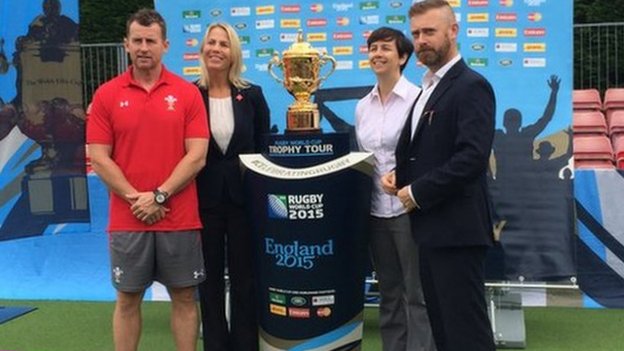
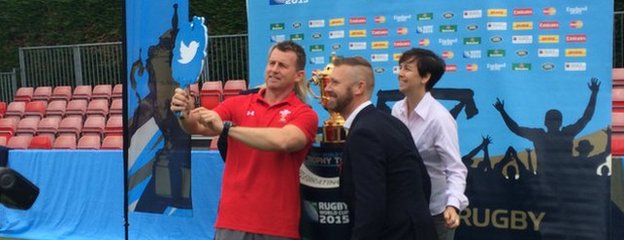
The Rugby World Cup trophy  stopped off at the Sports Wales National Centre in Cardiff recently as part of a 100-day tour across the UK and Ireland. The event, supported by Stonewall Wales, was held to encouraging everyone to get involved in sport. Gay friendly rugby teams were invited to meet the international referee, Nigel Owens and participate in a mini, yet slightly competitive, touch rugby tournament!

Get Inspired went along to meet the teams.
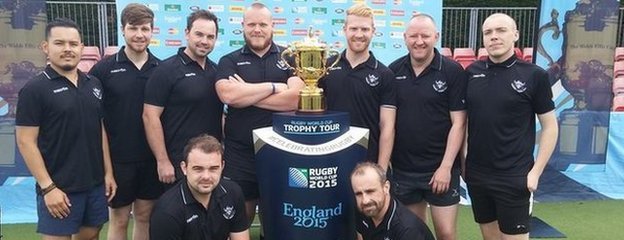
Swansea Vikings, Swansea’s first openly gay and inclusive rugby team, saw around 30 players turn up for training within a few weeks of forming, and only four of those had played rugby regularly before.
The club’s founder, or ‘The Chief’ as he’s most commonly known, Steven Larcombe, explained that the club “was built on a desire for gay men in Swansea to have their own rugby team, regardless of ability, experience or sexuality.” The only other gay inclusive team is in Cardiff.

The Chief, Steven Larcombe (fourth from left) with his fellow Vikings.

The Chief, Steven Larcombe (fourth from left) with his fellow Swansea Vikings.

In just 7 weeks the club recruited 46 new players, established a community of over 180 members, as well as campaigned in a number of LGBT (Lesbian, Gay, Bisexual and Transgender) matters, including sport, equality and inclusiveness.
“I hadn’t actually played rugby since school, and its the same for many others in the team so this is pretty new to everyone. Its an amazing achievement to be only the second gay & inclusive team in Wales, the 11th in the United Kingdom and 64th in the World!”

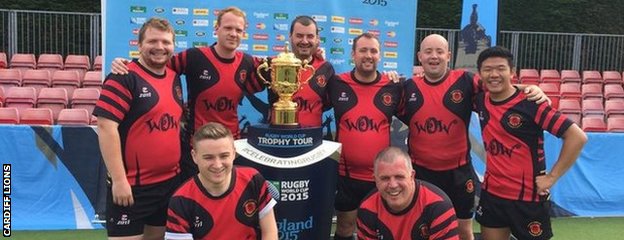
Cardiff Lions

The Cardiff Lions with the Webb Ellis Trophy as it travels around the UK ahead of the Rugby World Cup in September

Inclusivity is the core value of rugby

Following on from their recent success at the Biannual European gay-inclusive tournament, the Union Cup, the Cardiff Lions’ Gareth Waters and Chairman Christopher Whitton, are amazed with the surge in interest in the last few years.
“We are currently in our 11th year of existence and its growing exponentially. We now have a squad of over 40 players within the club, we play regular fixtures at least once or twice a month, and look forward to sending a team to the Bingham Cup  , the equivalent of the Gay Rugby World Cup in Nashville next summer, so there’s definitely a big interest in LGBT rugby, not just in Wales but around the world.
“Inclusivity is one of the core values of rugby and were just here to promote that. There’s definitely still work to be done but were going the right way!

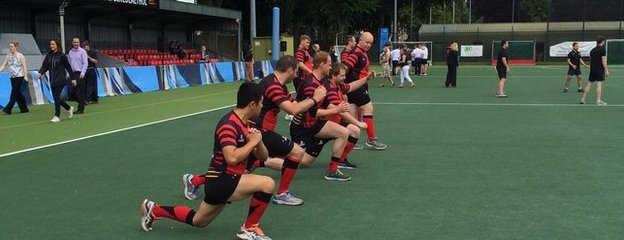
The Swansea Vikings doing some last minute stretching...

The Cardiff Lions doing some last minute stretching…

“Having the Webb Ellis trophy visit Wales based around the whole idea of inclusivity in rugby is a monumental occasion for LGBT sport. Its for everyone, and that’s what I’ve known since I was about 10 and started playing, it doesn’t matter what your size, strength, skin colour or sexual orientation, everyone can get involved!
Nigel Owens reiterated how important it is to be yourself in rugby.
“I’ve done it, as has Gareth Thomas and a lot of other people. Its about encouraging clubs to make the environment as welcoming and safe as possible, and in showing people who are thinking about it, or wondering if they can participate in sport, that they can.

Nigel Owens and co enjoying a selfie!

Step aside Kim Kardashian, there’s a new selfie king in town!

Although a positive role model within Welsh sport, Nigel sometimes get unhappy with people who portray the rugby community as homophobic, and feels that there is a lot of work to do to ensure that rugby is “acceptable and inclusive for all”.
“It is a safe environment to be in, and I encourage anyone who is interested to do so.”

The biggest challenge

According to Owens, the biggest challenge facing sport, rugby in particular, is what is defined by ‘Banter’, what is acceptable or not, and feels that the boundary lies with the individual and the team themselves.
“People within the environment need to be aware that what’s funny and banterous to one person, may not be to others – just think of what you say, but its important too that we must not lose that sense of humour within the sport. That’s the biggest challenge.
If you would like to give Rugby Union a try, take a look at our dedicated guideto get you started.

http://www.bbc.co.uk/sport/0/get-inspired/33366241

Filed Under: Anti-Bullying & Homophobia Tagged With: Rugby League, Rugby UNion, Rugby World Club

Press Release: CHE votes to support the LGBT History Project

06/07/2015 By ACOMSDave Leave a Comment

6 July 2015
At its 43rd Annual Conference in June 2015, The Campaign for Homosexual Equality (CHE) voted to support the LGBT History Project.
The LGBT History Project, founded by Jonathan Harbourne in June 2011, is an online archive of information about LGBT (Lesbian, Gay, Bisexual and Transgender) life in the United Kingdom from Julius Caesar to the present day. The archive, at http://www.lgbthistoryuk.org/wiki/, takes the form of a Wikipedia-style encyclopaedia with over 3,000 articles, covering every region, county, and local government district in the UK, and many famous and not so famous LGBT-related people, places, organisations  and events. The articles in the encyclopaedia have been viewed over four million times. The Project has recently become a Key Partner of LGBT History Month.
The Conference motion (full wording at http://c-h-e.org.uk/motions2015.shtml) urges CHE’s Executive Committee to work with other interested organisations to secure the long-term survival and enhancement of the Project, and the recruitment of additional volunteers.
CHE, founded in 1964, is the oldest LGBT member organisation in the country. With a wealth of history in its own archives, it is fully committed to preserving and documenting LGBT History, for instance by becoming a sponsor of LGBT History Month, and by commissioning the author Peter Scott-Presland to research and document its own history in the book Amiable Warriors (Volume One now available to buy: see http://www.amiable-warriors.uk/).

 
For further information, contact Ross Burgess at ross@foxearth.net , telephone 020 8645 0943 or 07899 985 064

Filed Under: Anti-Bullying & Homophobia, Campaigns, History Tagged With: campaign for homosexual equality, che, LGBT History Project

The Lost Pink Triangles

06/07/2015 By ACOMSDave Leave a Comment

An exhibition of Nazi persecution of homosexuals goes on display in NYC.

BY JAMES MCDONALD
JULY 06 2015 5:00 AM ET
A traveling exhibition produced by the United States Holocaust Memorial Museum, “Nazi Persecution of Homosexuals 1933–1945,” is now on view at the Museum of Jewish Heritage in New York City.
The show tells the story of Nazi persecution of homosexuals during World War II: Hitler’s genocide resulted in the death of 6 million Jews and millions of other people, with an estimated 5,000 to 15,000 sent to concentration camps because of their sexual orientations — the vast majority of them being gay men.
The story of these victims, commonly known as the Pink Triangles, has begun attracting attention relatively recently. Despite noted works like the play Bent, which was adapted into a film starring Clive Owen in 1997, and memoirs by former camp prisoners Gad Beck and Pierre Seel, gay stories have largely failed to become part of mainstream Holocaust narratives.
“The exhibition explores why homosexual behavior was identified as a danger to Nazi society and how the Nazi regime attempted to eliminate it,” says exhibition curator Edward Phillips.
“The Nazis believed it was possible to ‘cure’ homosexual behavior through labor and ‘re-education.’ ” Phillips says. “Their efforts to eradicate homosexuality left gay men subject to imprisonment, castration, institutionalization, and deportation to concentration camps.”
Between 1933 and 1945, more than 100,000 gay men were arrested for violating Nazi Germany’s ban on homosexuality. The exhibition includes personal accounts, photographs, and detailed information spanning this dark period of LGBT history.
MJHNYC.org, through October 2, 2015.

Filed Under: Anti-Bullying & Homophobia, History Tagged With: gay history, lgbt history, Nazi Germany, persecution, politics

Almost 70pc support for gay marriage in NI

06/07/2015 By ACOMSDave Leave a Comment

A rally in support of gay marriage in Belfast last month

A rally in support of gay marriage in Belfast last month


10:00Monday 06 July 2015
 
 
An overwhelming majority of Northern Ireland people now support gay marriage, a poll has suggested.
The Ipsos MORI survey found that 68 per cent of adults in the Province back the right of same-sex couples to marry.
The News Letter published a brief summary of the findings in Saturday’s paper.
We can now reveal more data.
The survey found that 82 per cent of the 16 to 34 age group support gay marriage, dropping slightly to 75 per cent among 35 to 54-year-olds, and falling sharply to 47 per cent of anyone older than that.
Support was highest in greater Belfast, at 75 per cent, and in other areas it dipped to 63 per cent support.
There was much higher support among Catholics (75 per cent) than Protestants (57 per cent).
Ipsos MORI broke down support by political affiliation. Support ranged from 80 per cent of Sinn Fein voters, to 79 per cent of Alliance voters, 61 per cent of SDLP voters, 49 per cent of Ulster Unionist voters, and 45 per cent of DUP voters.
Some people who saw Saturday’s report have asked about details for which we had no space, such as sample size.
Ipsos MORI say they asked 1,000 adults aged over 16 across Northern Ireland. Interviews were carried out in person from May 20 to June 8.
The data was weighted to match the population profile.
The pollsters say no other group commissioned the survey.
They asked the same question their London team asked in England prior to the 2013 law change there: “To what extent do you agree that homosexual couples should be allowed to marry each other?”
Prior to the Republic’s referendum, surveys over-estimated support for gay marriage by around seven per cent compared to the final 62 per cent Yes vote

Filed Under: Anti-Bullying & Homophobia, History Tagged With: gay marriage, marriage equality, Mori poll, same sex marriage

Brace gets Online Launch

05/07/2015 By ACOMSDave Leave a Comment


After a successful tour of 38 film festivals, Jake Graf’s short feature Brace finally gets its worldwide VoD release on July 1st.
The LGBTQ film that addresses issues of homophobia on the London scene has been warmly received at festivals including Frameline (San Francisco), Outfest (Los Angelos), Inside Out (Toronto) and Pink Apple (Zurich). Brace will next appear at home where you will be able to watch the film on Vimeo. The film is in English and will soon be available in French and Spanish subtitles.
Brace 1
Shot on location in some of London’s most notorious gay bars and clubs such as Heaven and (the sadly closed now) Manbar, Brace is a visually striking glimpse into London’s queer nightlife, and the perils that lurk behind the bright lights

Filed Under: Anti-Bullying & Homophobia, Movie Reviews Tagged With: Brace, London homophobia, online release

  • « Previous Page
  • 1
  • …
  • 28
  • 29
  • 30
  • 31
  • 32
  • …
  • 72
  • Next Page »

Categories

Copyright ACOMSDave.com © 2026