
ACOMSDave

Community Journalist

  • Home
  • Community Journalist
  • Events
  • Media Page and Press Kit
    • Projects and Work
  • Resources & Documents
    • LGBTQ+ Support Groups and Documents
  • NIGRA
  • Archives
  • Contact

Padraig Reidy: The “gay cake” case bedevils Northern Ireland

04/04/2015 By David McFarlane Leave a Comment

Editorial:  We have already reported that this case is currently in court and awaiting judgement; however the reason why I have picked this article up is because members of the Free Presbyterian Church decided to protest outside  Windsor Park before the Finland in a European Championship qualifier which was to be played for the first time on a Sunday.  

As I have stated before, I believe that everyone has a right to hold a ‘peaceful’ protest, however what is disheartening is when you also read that Conservative faith leaders have made religious liberty a rallying cry as gay marriage has spread throughout the states.  

It would appear that religious freedom must be granted no matter whose freedom gets trampled in the meantime.

Please let us know your thoughts?

Gay Cake Controversy

Religious right wants to constrict your freedom


By Padraig Reidy / 2 April, 2015
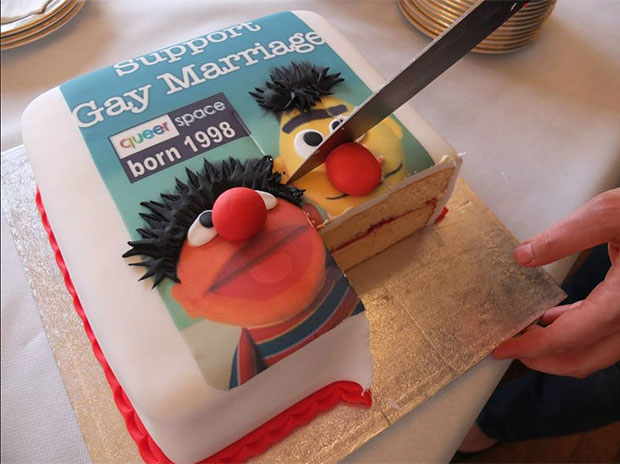
QueerSpace Belfast / Facebook
Last Sunday, as Northern Ireland’s footballers prepared to play Finland in a European Championship qualifier, protesters gathered outside Windsor Park, the team’s Belfast home.
The assembled were members of the Free Presbyterian Church. They were angered by the fact that Northern Ireland were playing on a Sunday  – the Sabbath  – for the first time ever.
Reverend Raymond Robinson told the Press Association: “Our opposition is to the breaking of observance of the Lord’s day.
“We believe in the Sabbath being kept holy. It seems more and more that the football agenda is being driven by the television companies and not what God says, or what public opinion is.”
Commentator Newton Emerson was, like many, blase about the protest, tweeting “I think these people are harmless enough now to just count towards our wonderful diversity.”
Be that as it may, Christian fundamentalism still plays a huge role in public life in Northern Ireland. While the old demands for Biblical propriety may seem archaic, a new struggle has emerged over what many religious people in the country see as threats to their religious freedom and way of life. And a cake has become the latest flashpoint.
Asher’s bakery is a business run by a family known for its Christian beliefs. It is named after one of the Biblical Twelve Tribes of Israel. Last summer, the bakery was asked to provide a cake by Gareth Lee, a volunteer for LGBT group QueerSpace.
Lee had requested a cake decorated with a picture of Sesame Street’s Bert and Ernie and the slogan “Support Gay Marriage”.
The bakery initially accepted the order, before then informing Lee that it could not fulfil the deal. The case went to Northern Ireland’s Equality Commission, and, between the jigs and reels, is now in the hands of district judge Isobel Brownie, who will rule on Monday whether the Christian bakers engaged in unlawful discrimination by not delivering the pro-same sex marriage cake.
Meanwhile, the “gay cake” case has raised the spectre of a “conscience clause” in equality legislation in Northern Ireland.
The whole situation is, quite frankly, pitiful. One can preach it, validly, both ways: fundamentalist bigots out of touch with the modern world, and inflicting their bigotry on others, or God-fearing, humble folk sticking by their beliefs in the face of an onslaught they didn’t invite.
I can’t help feel sympathetic towards the McArthurs, the family who own the bakery. Karen McArthur told the court that she had initially accepted the order to avoid embarrassment. Colin McArthur said “On that day I didn’t make a clinical decision. I was examining my heart. I was wrestling it over in my heart and in my mind.” He was, apparently, “deeply troubled”. “We discussed how we could stand before God and bake a cake like this promoting a case like this…”
On the other hand, Gareth Lee said he was left feeling like a lesser person after he was told his order would not be fulfilled.
This shouldn’t be down to who was more upset or offended, but then, on what criteria can we judge it? I don’t think it’s necessarily true to say that Lee is entitled to have any message he wants put on any cake by any person. The prosecution, correctly, pointed out that the message was rejected because of the word “gay”. The defence lawyers suggested that a ruling against the McArthurs could lead to a situation where devout Muslims were legally obliged to decorate cakes with images of Muhammad. While “you wouldn’t say that about the Muslims” is a tedious argument, and one deployed increasingly often by Christians, it’s not, in this case, an entirely unreasonable position.
Hardline Christians see homosexuality as a (wrong) choice people make, or a psychological disorder. I recall watching the Reverend Willie McRea, an MP, once, being asked what support he would offer to a constituent who was a victim of homophobia. McRea replied that he would advise the young man not go down that route: basically, the best way to prevent homophobia is to stop being gay.
Meanwhile, Iris Robinson, wife of Democratic Unionist Party leader Peter Robinson, firmly believes that one can be counselled away from homosexuality.
These people are odd, certainly, but they are not fringe characters who can be dismissed as irrelevant to mainstream society in Northern Ireland.
And even if these views were not mainstream, that would not make the fundamentals of the case any different. But it does seem as if the Equality Commission is trying to drag a segment of Northern Irish society kicking and screaming into the secular world.
So who’s right? Who should win? Reader, I am about to break the columnist’s solemn covenant and admit: I don’t fully know. This is not as clear cut a case of discrimination as, say, barring a gay couple from a Bed and Breakfast: if the McArthurs had simply refused to sell a cake to Lee, that would be clear cut. But the cake was loaded, so to speak. Should this tricky case lead to a “conscience clause” in equality legislation, then one can imagine legitimisation of genuinely discriminatory practices.
At the same time, the McArthurs, are wrong, and one’s initial inclination is to side with the gay rights activist against the religious fundamentalists. But that’s the problem with defending freedom of conscience, (and its expression in freedom of speech). Everyone’s conscience is different.
Northern Ireland beat Finland 2-1, by the way. God’s clearly not very troubled by Sunday football.
This column was posted at indexoncensorship.org on April 2, 2015
 
Further reading:

  • Religious freedom fight over gay marriage will persist

  • Girls’ Brigade taught homosexuality is a sin – equal to murder, stealing and adultery

Filed Under: Anti-Bullying & Homophobia Tagged With: Ashers bakery, Free Presbyterian Church, gay cake, Girls' Brigade, homosexuality, LGBT rights, personal freedom, religious freedom

My boyfriend killed himself because his family couldn’t accept that he was gay

25/03/2015 By David McFarlane Leave a Comment

Nazim Mahmood jumped to his death from a balcony seven months ago after coming out to his parents. His partner of 13 years, Matthew Ogston, talks to Sarfraz Manzoor
Matthew Ogston Nazeem Mahmood
Nazim Mahmood and Matthew Ogston in Iceland in 2008.
Sarfraz Manzoor
Saturday 21 March 2015 05.59 GMT Last modified on Monday 23 March 2015 15.32 GMT
In the spring of last year, Matthew Ogston and Nazim Mahmood moved into their dream home. The apartment, on the top floor of a mansion block in north-west London, offered stunning panoramic views of London. Nazim was a doctor who ran three London clinics, Matthew a web designer.
The life Nazim enjoyed seemed a world away from the working-class traditional Muslim community in which he had been raised. It was that world – conservative and closed – that he had left behind for a new life. In their first week in the flat, the two men stood on the balcony as London glittered in front of them. Matthew looked at Nazim and said, “Darling, I think we’ve finally made it.” They both smiled. Four months later, Nazim jumped off the edge of that same balcony to his death. He was 34.
Nazim was 21 when he met Matthew in November 2001. Matthew was at a gay nightclub in Birmingham, when Nazim approached with the words, “Excuse me, may I sit here?” Something about Nazim’s shy demeanour appealed to Matthew. They started talking. “There was an instant connection,” he recalls.
We are in the living room of the apartment. It is more than seven months since Nazim’s death but the condolence cards are still on display. This is the first time Matthew has agreed to talk openly, and during the hours we talk, words tumble and tears flow. It was only minutes after first meeting him that Nazim had said to Matthew: “I’m a Muslim, is that going to be a problem?”
Matthew Ogston
Matthew Ogston Facebook Twitter Pinterest
Matthew and Nazim with their dog Charlie in 2007.
The two were soon inseparable. Matthew was working as a web designer and Nazim was a medical student. Their families did not know they were gay. After a year they bought a house. It had two bedrooms so their families might assume they were just housemates. “We used to have to keep the window blinds in our front room closed so no one would see us,” says Matthew. “When we walked down the street we made sure there was some distance between us just in case a family member of his spotted us together.”
They grew tired of looking over their shoulders and wanted to stop hiding, so when Nazim was offered a job at a London hospital in 2004 they seized the opportunity to move to the capital. They would be far from their families, in a city where they knew no one and could fashion a new life together. “In London we felt free,” Matthew says. “We didn’t have to worry about bumping into our parents.”
They made friends and created a social world that reflected the people they were. Of necessity, this new life was founded on sadness and deceptions. Nazim was leading a double life: his family had barely met Matthew and thought he was merely an investor in their son’s flat. On the rare occasions they visited London, Matthew had to spend the night in a bed and breakfast. “We had to ‘de-gay’ the house,” says Matthew. “That meant putting pictures of Kylie into the cupboard, Cher too – and any photo or memento that suggested a relationship had to go.”
Nazim didn’t like to talk about his family. He had left Birmingham and felt that to talk about pain or sadness or guilt would have infected the new life they had created in London – he was resigned to playing the dutiful Muslim boy to his family in Birmingham when, in fact, he was a happily gay man in London.
To celebrate the 10th anniversary of their first meeting, Matthew and Nazim threw a party at a London club. Nazim was now a GP as well as running his own business – three London clinics that offered Botox treatments – and Matthew was doing well working for a software company. During the party, Matthew asked the DJ to lower the music. He led Nazim into the DJ booth, got down on one knee and proposed. “He looked at me and his face was just lit up,” says Matthew.
The following year, Matthew came out to his parents, who were loving and accepting of both of them, but for Nazim, whose family were culturally conservative Muslims, the only strategy was to keep the solid borderlines between the old life in Birmingham and the new life in London.
On the last Saturday of July 2014, Nazim and Matthew drove north to Birmingham. It was a strange time: a close friend had died and they had to be back in London on the Monday for his memorial service. It was also the weekend of Eid, the Muslim festival.
When he arrived, Nazim’s family were annoyed that he was late for the Eid celebrations and planned to leave early for the memorial. Things were said – Matthew does not know what, exactly – that left Nazim distraught. “I am a good person,” Nazim said, weeping. “Why can’t people accept me for who I am?”
“Is it because you like men?” his mother had asked him, out of the blue. And Nazim, who had spent years hiding and pretending, to protect his relationship with Matthew, did something he had never expected to do: on the spur of the moment, he told them everything.
Matthew Ogston
Matthew and Nazim at a friend’s wedding in 2005.
Nazim was in a state of shock as he drove back to London. It emerged at the inquest in December 2014 that he had told his mother he was gay and had been in a relationship with a man for 13 years, and planned to marry him. Her response was to tell Nazim to consult a psychiatrist with a view to being “cured”.
The coroner, Mary Hassell, ruled that Nazeem killed himself. She said: “It seems incredible that a young man with so much going for him could have taken his own life. But what I’ve heard is that he had one great sadness which was the difficulty his family had in accepting his sexuality.”
Nazim had never planned to reveal his sexuality and found it hard to process his mother’s extreme reaction.
The couple went to the service for their dead friend that evening and a second ceremony the following day, but Matthew recalls Nazim being distant, but trying to put on a brave face. On Tuesday evening, Nazim helped with paperwork for the new job Matthew would start the following morning and then they retired to bed.
In the office next day, Matthew got a text from his sister, saying simply “call me now”. It was early evening on Wednesday 30 July. He rang her and was told to go home immediately; she would not say why. It couldn’t be Nazim – they had talked at lunchtime and Nazim had called again at just after 3pm and then twice after 5pm, but it was Matthew’s first day in a new office and he had been too busy in meetings to take the calls, though he had tried to call Nazim back. Had there been a bomb scare at the flat?
As he left West Hampstead station Matthew began to run. “It was like I was running for my life,” he recalls.
As he speaks, he is clutching himself tightly, right hand gripping his biceps. “I was pushing people out of the way and as I came round the corner I saw flashing blue lights and police cordon tape, then I saw this red blanket on the floor covering something up.”
He began to scream. He was bundled into a police car as friends started to show up, faces grey with shock.

A TV interview with Matthew about the problems faced by many Asian men in coming out to their families.
Matthew arrived at Handsworth cemetery early on the day of Nazim’s funeral. In the aftermath of the death, Matthew had met Nazim’s family but the encounters were tense and uncomfortable. It appears that they did not want to have to deal with what they considered the shame of having had a gay son, and a gay son with a non-Muslim lover. Out of respect for Nazim’s mother’s plea not to make a scene at Nazim’s burial, Matthew agreed not to ask for a major role at the funeral, which was due to take place at 3.30pm.
With less than half an hour to go, nobody else had arrived and Matthew began to worry. In the distance he could see a burial taking place. “I went over and asked one of the officials where Nazim was being buried,” he said. “She said, ‘I’m really sorry – they have already buried him.’”
He ran out and saw Nazim’s family pouring dirt on to the coffin. “I was so angry,” Matthew tells me, tears streaming down his face, “I could not move. My arms and legs were just clenched. I felt completely betrayed.”
Nazim’s family had apparently given him the wrong time for the funeral.
He returned to London feeling desperately low. “I wanted to end it all,” he says quietly. “Follow Naz and leap off the balcony.”
His friends ensured he always had at least three people with him round the clock. “Every time I tried to get to the edge of the balcony, my friends would stop me. I couldn’t find a reason to stay alive.”
Then, in his distress, Matthew recalls: “I heard Naz’s voice.”
He is convinced that Nazim spoke to him, telling him to set up a foundation to help other young gay men and women driven to depression because of religious homophobia. He had a reason to go on at last.
The Naz and Matt Foundation was announced at a special service held in London for Nazim, two weeks after his funeral. The service featured contributions from a gay Muslim, gay Hindu, a gay vicar, a trainee Rabbi and a lesbian interfaith minister. Matthew has been seeing a psychotherapist but he doubts any counsellor can help to liberate him from the questions that haunt him. “I don’t have answers to the questions I have and I can’t find peace of mind because there are no answers.”
Who does Matthew blame for Nazim’s death? “I blame a community that is so closed minded to allow these bigoted views that make families believe that their honour is more important than loving their children,” he says. “The respect and honour of the family is more important than the happiness of the children they gave birth to. How sick is that?”
The purpose of the Naz and Matt Foundation is to confront and challenge these views. Matthew says the foundation has given him a reason to stay alive but he is still finding it hard to come to terms with Nazim’s death. “I am on medication for sleep and anxiety,” he says. “I can’t face going to sleep because I know I will have to wake up and face more sadness, because he’s not there.”
Nazim is gone but in the home they shared he is everywhere. A large painting of him rests against one wall, photographs arranged around the room. The condolence cards read “With deepest sympathy”, and “So sorry for your loss” and so on.
We have talked for more than five hours and Matthew looks emotionally exhausted as I prepare to leave. A digital picture frame has settled on an image from the party where Matthew proposed to Nazim. They were engaged for three years but didn’t marry. “I have applied to have my name changed by deed poll to the name I would have adopted when we got married,” he says.
Why didn’t they get married? “Naz said it would not feel right to marry without being able to invite his mother,” says Matthew. “He wanted the unconditional love of his mum – that was all he had ever wanted: love and acceptance.”
nazandmattfoundation.org
@sarfrazmanzoor
Samaritans: 08457 909090 (24-hour national helpline)
 
Read more: http://www.theguardian.com/lifeandstyle/2015/mar/21/my-boyfriend-killed-himself-because-his-family-couldnt-accept-that-he-was-gay

Filed Under: Anti-Bullying & Homophobia Tagged With: Bereavement, Birmingham, Death and dying, Doctors, family, gay marriage, homophobia, Islam, LGBT rights, Parents and parenting

Struggle for LGBT rights remembered in Westminster banner

12/03/2015 By David McFarlane Leave a Comment

Paula Stevens-Hoare with Ruth Hunt. the CEO of Stonewall (all images: ParliOUT, Paula Stevens-Hoare, UK Parliament)

Paula Stevens-Hoare with Ruth Hunt. the CEO of Stonewall (all images: ParliOUT, Paula Stevens-Hoare, UK Parliament)


Reprinted from Pink News –
11th February 2015, 5:47 PM

  • Molly Rose Pike

 
An exhibition of banners celebrating 800 years of constitutional history, which features one about LGBT rights, has been unveiled at Westminster Hall.
Paula Stevens-Hoare has launched her banner at a talk hosted by ParliOUT, commemorating the struggle for LGBT rights in the time of significant legislation.
“My hope for the banner is that it poses as many questions as it answers.” said artist Paula Stevens-Hoare.
Her 1967 Sexual Offences Act banner was created to remember the struggle of the fight for rights but also celebrate the progress made since early legislation. It will be on display in Westminster Hall in the Houses of Parliament until November.
Paula, who was born in the same year homosexuality was decriminalised, particularly wanted to promote the achievements for LGBT rights made by wome. The banner features April Ashley, one of the first people to undergo gender reassignment surgery in the ’60s and Ruth Hunt, the CEO of Stonewall.
The banner also features silhouettes of little-known activists, the three women who abseiled onto the Floor of the House of Lords in protest against Section 28- legislation that stated that homosexuality must not be ‘promoted’ as an acceptable lifestyle. Paula was particularly fascinated by these women because nobody is still quite sure who they were.
She told PinkNews: “I’m a bloody feminist. Women’s achievements for LGBT rights aren’t as well documented because women generally aren’t as well documented.
“I suppose whilst I acknowledge that homosexuality for men was criminalised it was more pertinent to them to get the law changed, I recognised there were probably women involved in those campaigners but they probably weren’t in positions of authority or power and weren’t able to make those changes. I particularly wanted to add women to make that gender balance a little bit better.”
The banner features a ribbon connecting the very beginning of the movement to the struggles it faces today. The knots in the ribbon represent the times when the struggle for LGBT rights was very tough, such as Oscar Wilde’s arrest and sentencing and the fight to repeal Section 28.
Paula told Pink News that she hoped the banner would do exactly what Section 28 didn’t want LGBT people to do- promote equal rights.
“I love that it does that. I hope that school kids, anybody and everybody, but especially school kids, will ask questions passing the banner and think about what’s been achieved and what’s still left to achieve. That they will have the confidence to come out if they feel they want to and have the support and help of friends, allies and teachers.”
Ruth Hunt, CEO of Stonewall, told PinkNews that the fight for LGBT rights is not over and the next big change has to be transgender rights.
“The bigger change is how we can inspire LGBT people to get involved in politics in its widest sense and be interested and concern about legislation across the piece.”
Ruth said that the piece is important to remind us of the vitality of remembering our history: “It’s really important that we remember where we’ve come from. It’s our DNA as a movement, if we forget where we’ve come from we can’t safeguard our future.
For Paula Stevens-Hoare, remembering the struggle is personal: “I think seeing how things have changed within my life time gives me great hope for what’s coming next.”
‘The Beginnings of that Freedome’ banners exhibition is on now until November.

Filed Under: Anti-Bullying & Homophobia Tagged With: celebration, exhibition, LGBT rights, westminster hall

An participant's report on Belfast Pride 2013

17/07/2013 By David McFarlane Leave a Comment

Belfast Telegraph - Picture of Belfast Pride 2013Last weekend Belfast LGBT pride march was very successful, and as a Gay man i was proud to march with a poster calling for the  ‘freedom of Bradley Manning’,  a Gay man jailed in the Untied States for exposing war crimes against humanity.
Belfast pride is now the biggest LGBT pride in Ireland , while this is a victory we must remember why we are marching .  Homophobia has died down but it is not yet fully dead and until it is dead we must march with pride and stand in solidarity with the LGBT movement to kill it.
Here in the North of Ireland Gay and Bi sexual men are refused the right to give blood and blood is a much need thing to save lives , yet Gay and Bisexual men can not give blood that would save peoples lives  –  this is being seen as outright Homophobia by Health Minster Edwin Poots., and illogical in the light of measures taken in other parts of the United Kingdom.
Both the Orange order and the Catholic church stand united in their opposition to LGBT marriage.  The right of LGBT Northern Irish Citizens to marriage is a right that Stormont has blocked.
Queer bashing is still something that many LGBT people in the North of Ireland encounter, and they suffer mental heath issues which results in them taking their own lives.
Many LGBT people in the North still have a fear about coming out.  In state schools many young LGBT students face homophobic bullying which the schools do not proactively handle.  Until and unless the school system in the North Of Ireland is separated from the church , this abomination of abuse of power by the church will continue to impact on LGBT youth.
The word GAY means Good as You and we are.  Some day we shall have our liberation and no more shall Gay people live in fear  We shall over come some day.
 
Seán óg Garland


Filed Under: History Tagged With: belfast pride 2012, bi-sexual, civil liberties, gay, lesbian, LGBT rights, pride 2013, transgender

  • « Previous Page
  • 1
  • 2
  • 3

Categories

Copyright ACOMSDave.com © 2026