
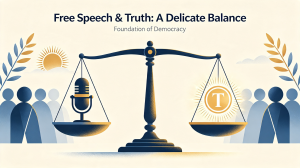
 Free speech is the lifeblood of democracy — but it should never come at the expense of truth. Honesty matters in public life, yet balancing freedom of expression with a shared right to factual accuracy remains one of the hardest debates in modern governance. Democratic societies protect free speech to safeguard dissent, creativity, and accountability — but legally defining and policing “truth” carries profound risks: it could hand the state power to censor inconvenient views, and what counts as “truth” is often subjective or evolving.
The cost of unchecked falsehood is already clear. Misinformation erodes public trust in elections, public health, and shared institutions. When lies spread faster than facts, citizens cannot make informed choices or hold leaders to account. Worse, social media algorithms prioritise engagement over accuracy — amplifying sensational, misleading, or harmful content because it drives clicks, not because it is true. This bias distorts public discourse and weakens democracy’s foundation: an informed citizenry.
Yet enshrining a broad “right to truth” in law carries its own dangers. Giving any government the power to define what is true opens the door to abuse. Valid dissent, minority perspectives, and emerging scientific understanding could be silenced as “untrue” by those in power. Facts change — what was accepted as settled knowledge decades ago may be revised today. A rigid legal standard risks becoming a weapon, not a shield, applied unevenly to target opponents rather than falsehoods.
Crucially, we already have a balanced approach. Existing laws punish specific harms — fraud, defamation, perjury — without creating a vague, sweeping legal duty to “tell the truth.” This framework protects individuals from tangible harm while preserving the space for debate, discovery, and disagreement.
The goal should not be to legally mandate universal truth — an impossible and dangerous standard. Instead, we must defend free speech and invest in accuracy, so citizens can distinguish fact from falsehood for themselves. Free speech should not cost the truth — but neither should protecting truth cost us our freedom.
Links:
Leave a Reply